







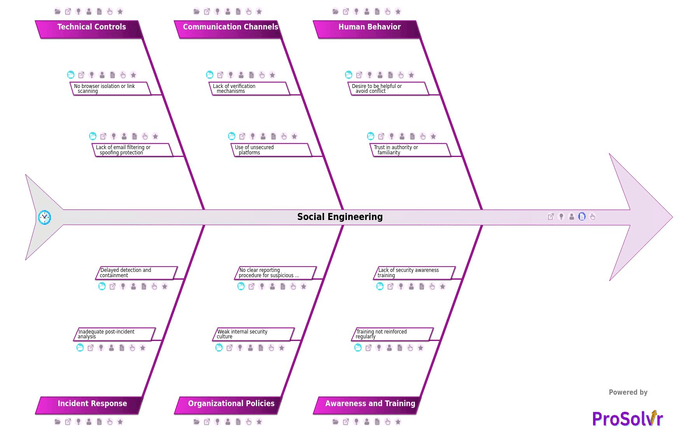
RCA of Social Engineering
Social engineering is a psychological manipulation technique that exploits human behavior rather than technical vulnerabilities. Attackers impersonate known individuals and use trust in authority or familiarity to persuade employees to reveal confidential information, approve payments, click malicious links, or provide unauthorized access. They may also exploit the desire to be helpful or avoid conflict, while employees may fear repercussions for refusal.
Awareness and training are essential for reducing social engineering risks. However, many organizations provide training that is not reinforced regularly, with no follow-up simulations or refreshers. A lack of security awareness training can leave users unaware of phishing and impersonation tactics. The risk increases when communication channels lack verification mechanisms, use personal email and messaging apps for work, or rely on unsecured platforms without multi-factor identity confirmation.
Organizational policies and technical controls also play a critical role. A weak internal security culture may develop when security is not prioritized across all departments, employees are unsure how to respond to threats, and there is no clear reporting procedure for suspicious activity. In addition, a lack of email filtering or spoofing protection may allow spoofed messages to bypass spam detection. Without browser isolation or link scanning, users may also be exposed to malicious links directly.
After a social engineering incident, organizations should conduct a structured Root Cause Analysis instead of focusing only on individual mistakes. Inadequate post-incident analysis, delayed detection and containment, and a lack of monitoring for social engineering indicators can allow similar incidents to recur. ProSolvr uses GenAI-powered fishbone diagrams to identify weaknesses across human behavior, awareness and training, communication channels, organizational policies, technical controls, and incident response. This approach helps organizations translate lessons into preventive actions, assign accountability, and implement focused corrective and preventive actions.
Who can learn from the Social Engineering template?
- Cybersecurity Professionals: These individuals can use the RCA to better understand human-centric vulnerabilities that are often overlooked in technical audits. The structured insights help them design more holistic defense strategies that integrate both technological and behavioral safeguards.
- HR and Training Departments: By examining the breakdown in employee behavior and awareness, HR and training teams can refine onboarding programs and continuous learning modules. The RCA highlights where knowledge gaps exist, enabling more targeted and effective training interventions.
- IT and Infrastructure Teams: This group gains a deeper appreciation for how procedural weaknesses and system misconfigurations contribute to social engineering risks. The RCA framework helps them prioritize technical controls that align with human behavior patterns and organizational workflows.
- Management and Policy Makers: Leadership teams can use the RCA findings to understand the cultural and procedural shortcomings that allow social engineering to succeed. This awareness supports better decision-making around policies, resourcing, and accountability mechanisms.
- Incident Response Teams: For those tasked with containment and recovery, the RCA reveals post-incident process failures and response delays. This allows them to improve playbooks, escalation paths, and feedback loops for future events.
Why use this template?
ProSolvr enables stakeholders from different departments to contribute insights, categorize potential causes, and support CAPA implementation. This collaborative approach makes problem-solving more transparent and turns Root Cause Analysis into a continuous improvement process rather than a one-time review.
By combining hierarchical root cause analysis with Six Sigma principles, ProSolvr helps organizations develop sustained, evidence-based solutions. These actions can reduce future social engineering risks while strengthening the organization’s cybersecurity culture.
Use ProSolvr by smartQED to investigate social engineering incidents, identify systemic weaknesses, and resolve problems more efficiently across your organization.


