






ProSolvr logo

Resolve problems, permanently

Server-Side Request Forgery RCA

RCA of Server-Side Request Forgery

Server-Side Request Forgery RCA helps cybersecurity teams investigate why SSRF vulnerabilities occur, identify missing controls, and define corrective and preventive actions. Server Side Request Forgery (SSRF) is a security vulnerability that occurs when an application uses user supplied input to make server side requests without proper input validation...

SSRF often results from application design and server configuration gaps. Applications that fetch external resources without restricting destination IPs or domains can expose internal services, such as cloud metadata endpoints or internal APIs. These risks increase when outbound traffic is unrestricted and internal services are accessible from the application server.

SSRF incidents are difficult to detect because logging, monitoring, and testing controls are often inadequate. Unusual outbound traffic may not trigger alerts, request logging may be insufficient, and security testing frequently excludes server side attack scenarios. As a result, SSRF weaknesses can remain unnoticed until serious damage has occurred.

When SSRF incidents occur, organizations need a structured way to understand what failed and why. ProSolvr supports Root Cause Analysis using AI powered fishbone diagrams and Six Sigma principles to identify contributing factors and define effective Corrective and Preventive Actions. This helps teams move from one time fixes to long term prevention.

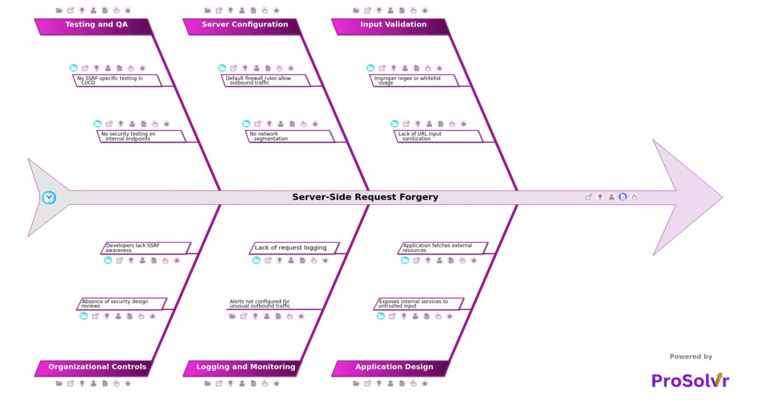
Server-Side Request Forgery

    • Input Validation
      • Improper regex or whitelist usage
        • Bypass via URL encoding or redirects
      • Lack of URL input sanitization
        • Direct user input used in requests
    • Application Design
      • Exposes internal services to untrusted input
        • Cloud metadata endpoint accessible
      • Application fetches external resources
        • No restrictions on destination IPs or domains
    • Server Configuration
      • Default firewall rules allow outbound traffic
        • No egress filtering in place
      • No network segmentation
        • Internal services accessible from app server
    • Logging and Monitoring
      • Alerts not configured for unusual outbound traffic
        • Lack of request logging
      • No traceability for internal access
    • Testing and QA
      • No SSRF-specific testing in CI/CD
        • Lack of automated dynamic security scans
      • No security testing on internal endpoints
        • Internal APIs not part of test cases
    • Organizational Controls
      • Absence of security design reviews
        • SSRF risks not documented during design
      • Developers lack SSRF awareness
        • No training on server-side attack vector

Suggested Actions Checklist

Here are some corrective actions, preventive actions and investigative actions that organizations may find useful:

    • Input Validation
      • Improper regex or whitelist usage
        • Corrective Actions:
          • Review and fix existing regular expressions and whitelists used for input validation to ensure comprehensive coverage of valid formats and rejection of harmful input.
        • Preventive Actions:
          • Establish coding standards for secure regex and whitelist implementations with peer review requirements.
        • Investigative Actions:
          • Audit past input validation implementations to identify common regex/whitelist misuse patterns.
      • Lack of URL input sanitization
        • Corrective Actions:
          • Implement robust URL sanitization and validation logic for all user inputs used in HTTP requests.
        • Preventive Actions:
          • Integrate a security library for URL validation as part of development frameworks.
        • Investigative Actions:
          • Review all points in the codebase where user input is used in URL construction to identify sanitization gaps.
    • Application Design
      • Exposes internal services to untrusted input
        • Corrective Actions:
          • Implement access control rules that restrict internal service communication based on trust boundaries.
        • Preventive Actions:
          • Introduce threat modeling in the design phase to account for internal service exposure risks.
        • Investigative Actions:
          • Map the flow of untrusted input to internal services and identify any unauthorized access patterns.
      • Application fetches external resources
        • Corrective Actions:
          • Restrict external resource fetching to a fixed list of trusted domains.
        • Preventive Actions:
          • Implement an allowlist policy for outbound HTTP requests.
        • Investigative Actions:
          • Analyze logs to identify patterns of external resource access and verify their legitimacy.
    • Server Configuration
      • Default firewall rules allow outbound traffic
        • Corrective Actions:
          • Harden firewall configurations to block all outbound traffic by default, allowing only specific destinations.
        • Preventive Actions:
          • Include firewall configuration checks in deployment automation.
        • Investigative Actions:
          • Examine firewall rule sets across environments to identify over-permissive defaults.
      • No network segmentation
        • Corrective Actions:
          • Introduce logical segmentation of the network to isolate internal services from the application server.
        • Preventive Actions:
          • Design all new deployments with segmented network architecture using VLANs or subnets.
        • Investigative Actions:
          • Conduct a network architecture review to locate cross-boundary communication paths.
    • Logging and Monitoring
      • Alerts not configured for unusual outbound traffic
        • Corrective Actions:
          • Configure alerting mechanisms for anomalous outbound request patterns.
        • Preventive Actions:
          • Establish baseline traffic profiles and build detection rules in SIEM tools.
        • Investigative Actions:
          • Analyze historical traffic to identify missed opportunities for alerting.
      • Lack of request logging
        • Corrective Actions:
          • Enable detailed request logging for all inbound and outbound HTTP/S traffic.
        • Preventive Actions:
          • Make logging mandatory in application design and coding standards.
        • Investigative Actions:
          • Determine the visibility gaps by evaluating incidents where logs were unavailable.
    • Testing and QA
      • No SSRF-specific testing in CI/CD
        • Corrective Actions:
          • Incorporate SSRF-specific test cases into the continuous integration/continuous deployment pipelines.
        • Preventive Actions:
          • Develop reusable security testing modules that target SSRF vectors.
        • Investigative Actions:
          • Review past pipeline test results to identify gaps related to SSRF.
      • No security testing on internal endpoints
        • Corrective Actions:
          • Include internal endpoints in the security testing scope using internal scanning tools.
        • Preventive Actions:
          • Update testing policies to require internal endpoint coverage.
        • Investigative Actions:
          • Conduct a threat assessment on internal endpoints to estimate risk exposure.
    • Organizational Controls
      • Absence of security design reviews
        • Corrective Actions:
          • Establish a formal process for security design reviews as part of the development lifecycle.
        • Preventive Actions:
          • Require security sign-off for all high-risk feature deployments.
        • Investigative Actions:
          • Examine past architecture changes that were not subjected to security review.
      • Developers lack Server-Side Request Forgery awareness
        • Corrective Actions:
          • Organize targeted workshops on Server-Side Request Forgery vulnerabilities and remediation.
        • Preventive Actions:
          • Add Server-Side Request Forgery topics to developer onboarding and regular training schedules.
        • Investigative Actions:
          • Conduct developer surveys or interviews to gauge current knowledge levels.
 

Who can learn from the Server-Side Request Forgery template?

  • Software Developers: They gain awareness of the common categories of weaknesses that lead to SSRF vulnerabilities, helping them design safer applications and implement better input validation practices.
  • Cybersecurity Analysts and Incident Responders: They can use the template as a framework to understand where SSRF risks commonly arise, assisting in faster identification and containment of incidents.
  • Quality Assurance (QA) and Testing Teams: The template helps QA teams design test cases and security assessments focusing on potential SSRF entry points, improving overall application security before release.
  • IT and Network Administrators: Learning from the template helps administrators understand network-level implications of SSRF, such as firewall configurations and network segmentation, strengthening infrastructure defenses.
  • Security Trainers and Awareness Educators: Trainers can use the SSRF template to create educational materials and workshops that raise awareness among various technical and non-technical stakeholders about SSRF risks and mitigation strategies.

Why use this template?

SSRF is a dangerous vulnerability with potentially devastating effects. Post-incident root cause analysis using AI-powered fishbone tools grounded in Six Sigma can convert incidents into opportunities for deep learning and organizational improvement, reducing the likelihood of recurrence and elevating overall cybersecurity posture. ProSolvr allows cybersecurity teams to visually map out causes that helps build long-term resilience into systems by closing gaps that might otherwise remain hidden.

Use ProSolvr by smartQED to systematically resolve issues in your organization.

Curated from community experience and public sources:

  • https://owasp.org/www-community/attacks/Server_Side_Request_Forgery
  • https://www.imperva.com/learn/application-security/server-side-request-forgery-ssrf/
