






ProSolvr logo

Resolve problems, permanently

Root Cause Analysis of Poor Build Quality

Root Cause Analysis of Poor Build Quality

Poor build quality in automobiles refers to the use of substandard materials, flawed manufacturing processes, inadequate quality control, and cost-driven compromises that negatively impact vehicle durability, safety, and overall customer satisfaction. For any automobile brand, poor build quality can have serious repercussions.

If vehicles exhibit issues such as thin paint coatings leading to early fading, brittle interior plastics, high rust susceptibility due to thin gauge steel, or weak spot welds from inconsistent robotic welding, customers may start perceiving the manufacturer as unreliable. In addition, loose-fitting panels, poor crash safety design with inadequate crumple zone optimization, and excessive cabin noise due to a focus on lightweight builds can lead to negative word-of-mouth, increased warranty claims, and declining resale values. When buyers prioritize safety, durability, and premium finishes, repeated reports of structural weaknesses can push them toward competitors that offer better build quality.

Moreover, supplier issues such as inadequate inspections, variability in part specifications, and sourcing of cheap alternative materials can further degrade the final product, leading to increased recalls and reputational damage. In the long run, such problems can erode customer trust, reduce brand loyalty, and impact sales performance, especially in markets where safety ratings and vehicle longevity are critical purchasing factors.

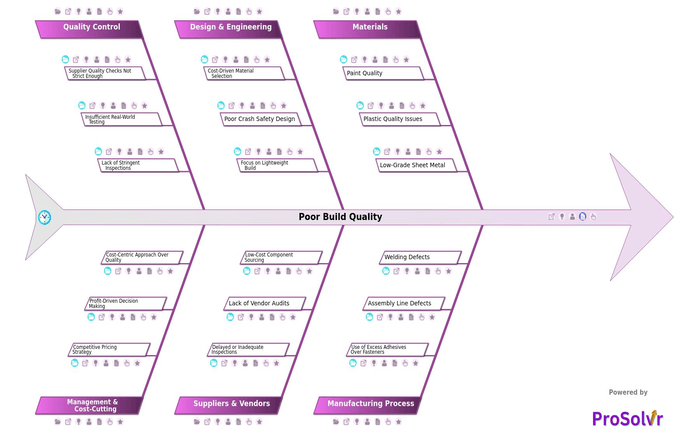
After an incident occurs, conducting a thorough root cause analysis (RCA) is crucial to identifying and addressing the underlying reasons behind the quality issues. A GEN-AI-powered root cause analysis application like ProSolvr, that uses a fishbone diagram integrated with Six Sigma principles can be instrumental in systematically pinpointing the root causes of build quality problems.

By categorizing potential causes under key factors, the analysis enables a structured investigation, ensuring that no critical area is overlooked. Once the root causes are identified, organizations can develop Corrective and Preventive Actions (CAPA) to not only fix current defects but also prevent recurrence by refining quality control measures, adjusting supplier contracts, or revising material selection criteria.

Poor Build Quality

    • Materials
      • Paint Quality
        • Poor adhesion leading to early fading
        • Thin paint coating
      • Plastic Quality Issues
        • Low heat resistance
        • Brittle interior plastics
      • Low-Grade Sheet Metal
        • High rust susceptibility
        • Thin gauge steel
    • Manufacturing Process
      • Use of Excess Adhesives Over Fasteners
        • Panels detaching over time
        • Reduced structural integrity
      • Assembly Line Defects
        • Inaccurate part alignment
        • Loose-fitting panels
      • Welding Defects
        • Inconsistent robotic welding
        • Weak spot welds
    • Design & Engineering
      • Cost-Driven Material Selection
        • Low durability of parts
        • Weaker structural components
      • Poor Crash Safety Design
        • Poor crumple zone optimization
        • Low Global NCAP ratings
      • Focus on Lightweight Build
        • Increased cabin noise
        • Less structural rigidity
    • Suppliers & Vendors
      • Delayed or Inadequate Inspections
        • Increased recall instances
        • Late defect identification
      • Lack of Vendor Audits
        • Variability in part specifications
        • Non-compliance with quality standards
      • Low-Cost Component Sourcing
        • Cheap alternative materials used
        • Inconsistent supplier quality
    • Quality Control
      • Supplier Quality Checks Not Strict Enough
        • Failure to impose penalties for defects
        • Limited traceability of defective parts
      • Insufficient Real-World Testing
        • Lack of long-term durability tests
        • Poor road condition simulations
      • Lack of Stringent Inspections
        • Tolerant rejection criteria
        • Random batch testing instead of full inspection
    • Management & Cost-Cutting
      • Competitive Pricing Strategy
        • Compromises in build quality
        • Need to keep production costs low
      • Profit-Driven Decision Making
        • Limited investment in R&D for structural improvements
        • High-margin focus on fuel efficiency over safety
      • Cost-Centric Approach Over Quality
        • Avoidance of high-strength alloys
        • Preference for cheaper materials

Suggested Actions Checklist

Here are some corrective actions, preventive actions and investigative actions that automobile plants can make use of.

    • Materials
      • Paint Quality
        • Corrective Actions:
          • Improve paint formulation and increase coating thickness to prevent fading.
        • Preventive Actions:
          • Implement automated thickness monitoring and adhesion tests during production.
        • Investigative Actions:
          • Analyze environmental factors (UV exposure, humidity) impacting paint longevity.
      • Plastic Quality Issues
        • Corrective Actions:
          • Source high-grade, heat-resistant plastic for interior components.
        • Preventive Actions:
          • Set stricter heat resistance standards for suppliers and conduct thermal endurance testing.
        • Investigative Actions:
          • Evaluate supplier raw material composition and defect history.
      • Low-Grade Sheet Metal
        • Corrective Actions:
          • Upgrade sheet metal specifications to improve rust resistance and thickness.
        • Preventive Actions:
          • Implement corrosion-resistant coatings and stricter quality verification.
        • Investigative Actions:
          • Conduct failure analysis on rusted components to identify weak points.
    • Manufacturing Process
      • Use of Excess Adhesives Over Fasteners
        • Corrective Actions:
          • Redesign joints to optimize fastener usage and minimize adhesive reliance.
        • Preventive Actions:
          • Train assembly staff and refine process standards for optimal adhesive application.
        • Investigative Actions:
          • Perform structural integrity tests on adhesive-bonded parts.
      • Assembly Line Defects
        • Corrective Actions:
          • Introduce real-time alignment monitoring systems to prevent misfits.
        • Preventive Actions:
          • Conduct routine calibration and operator training to improve precision.
        • Investigative Actions:
          • Analyze defect frequency data to determine process failure points.
      • Welding Defects
        • Corrective Actions:
          • Adjust robotic welding parameters for consistent spot welds.
        • Preventive Actions:
          • Implement non-destructive testing (NDT) for quality verification.
        • Investigative Actions:
          • Review welding logs and inspect failed weld joints.
    • Design & Engineering
      • Cost-Driven Material Selection
        • Corrective Actions:
          • Reevaluate material choices to balance cost and durability.
        • Preventive Actions:
          • Introduce long-term cost-benefit analysis for material selection.
        • Investigative Actions:
          • Compare durability test results of alternative materials.
      • Poor Crash Safety Design
        • Corrective Actions:
          • Redesign crumple zones and reinforce high-impact areas.
        • Preventive Actions:
          • Conduct computer simulations and crash tests before finalizing designs.
        • Investigative Actions:
          • Examine crash test failure reports and customer accident data.
      • Focus on Lightweight Build
        • Corrective Actions:
          • Strengthen structural reinforcements while maintaining weight efficiency.
        • Preventive Actions:
          • Use advanced materials (e.g., high-strength steel) for lightweight yet rigid structures.
        • Investigative Actions:
          • Assess cabin noise and rigidity complaints from real-world vehicle tests.
    • Suppliers & Vendors
      • Delayed or Inadequate Inspections
        • Corrective Actions:
          • Enforce immediate in-house inspections for incoming materials.
        • Preventive Actions:
          • Require suppliers to conduct pre-dispatch inspections and certification.
        • Investigative Actions:
          • Analyze defect trends linked to supplier batches.
      • Lack of Vendor Audits
        • Corrective Actions:
          • Increase frequency of vendor quality audits and compliance checks.
        • Preventive Actions:
          • Establish mandatory supplier evaluation protocols before contracts.
        • Investigative Actions:
          • Compare defect rates from audited vs. non-audited vendors.
      • Low-Cost Component Sourcing
        • Corrective Actions:
          • Source components from reputable, high-quality suppliers.
        • Preventive Actions:
          • Implement minimum quality benchmarks for supplier selection.
        • Investigative Actions:
          • Conduct root cause analysis on failure-prone components.
    • Quality Control
      • Supplier Quality Checks Not Strict Enough
        • Corrective Actions:
          • Impose penalties for consistent defects and enforce stricter rejection criteria.
        • Preventive Actions:
          • Implement traceability measures for defective parts.
        • Investigative Actions:
          • Review supplier defect logs and trace issues to production batches.
      • Insufficient Real-World Testing
        • Corrective Actions:
          • Expand durability testing programs to simulate extreme conditions.
        • Preventive Actions:
          • Increase pre-launch endurance testing cycles.
        • Investigative Actions:
          • Examine failure rates from long-term customer usage data.
      • Lack of Stringent Inspections
        • Corrective Actions:
          • Implement 100% inspection for critical components.
        • Preventive Actions:
          • Standardize defect rejection criteria and improve training.
        • Investigative Actions:
          • Audit random batch test records for overlooked defects.
    • Management & Cost-Cutting
      • Competitive Pricing Strategy
        • Corrective Actions:
          • Balance cost-cutting measures with necessary quality improvements.
        • Preventive Actions:
          • Conduct periodic assessments to align pricing with sustainable quality.
        • Investigative Actions:
          • Compare product durability in cost-cutting vs. premium models.
      • Profit-Driven Decision Making
        • Corrective Actions:
          • Allocate resources for R&D focusing on safety and structural integrity.
        • Preventive Actions:
          • Create a long-term investment strategy that prioritizes safety alongside cost.
        • Investigative Actions:
          • Evaluate industry benchmarks on safety investments vs. profit margins.
      • Cost-Centric Approach Over Quality
        • Corrective Actions:
          • Introduce alternative high-strength yet cost-effective materials.
        • Preventive Actions:
          • Encourage innovation in material sourcing without compromising quality.
        • Investigative Actions:
          • Assess warranty claims and customer complaints linked to material failures.
 

Who can use the Poor Build Quality template?

  • Automobile Manufacturers & Engineers: Professionals in the automotive industry, including design engineers, quality assurance teams, and production managers, can use the insights to improve material selection, manufacturing processes, and quality control to prevent recurring issues.
  • Supply Chain & Vendor Managers: Those responsible for sourcing raw materials and components can learn about the impact of low-cost component sourcing, inadequate inspections, and lack of vendor audits on final product quality, ensuring stricter supplier regulations.
  • Six Sigma & Quality Control Practitioners: Experts in lean manufacturing, Six Sigma methodologies, and process improvement can use the fishbone diagram approach to analyze quality failures and implement corrective and preventive actions (CAPA).
  • Business & Management Executives: Decision-makers in automotive firms and manufacturing companies can understand how cost-driven material selection, profit-centric strategies, and insufficient R&D investment contribute to product failures and customer dissatisfaction.
  • Consumer Advocacy Groups & Safety Regulators: Organizations focused on vehicle safety, Global NCAP ratings, and consumer rights can use the framework to advocate for higher manufacturing standards and stricter regulations to protect buyers.

Why use this template?

An AI-powered root cause analysis application such as ProSolvr, which integrates fishbone diagramming with Six Sigma methodologies, can significantly enhance the problem-solving process. By mapping issues like thin paint coatings, inconsistent supplier quality, loose-fitting panels, and weak spot welds to their root causes, ProSolvr helps manufacturers identify systematic failures rather than treating symptoms in isolation. The structured insights provided by such a application can help automobile manufacturers strengthen their quality assurance processes, refine supplier contracts, and optimize production methodologies to enhance vehicle reliability and safety.

Use ProSolvr by smartQED to effectively solve problems in your organization.

Curated from community experience and public sources:

  • https://eines.com/the-7-deadly-sins-of-automotive-quality-control/
  • https://roadsafetyguy.com/good-car-build-quality/
