







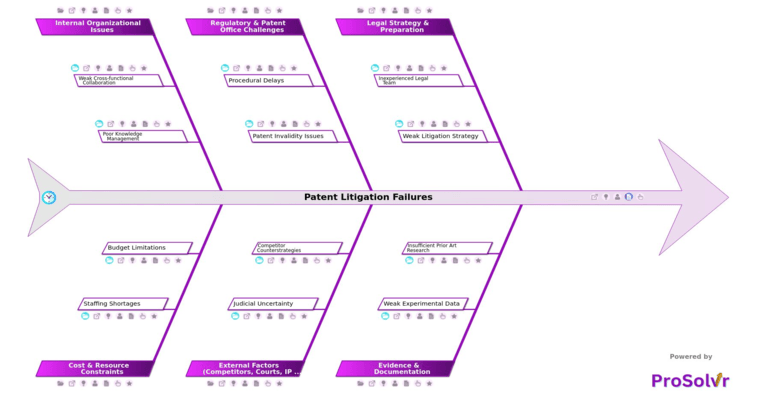
RCA of Patent Litigation Failures
Patent litigation failures occur when pharmaceutical companies are unable to successfully defend or enforce their intellectual property rights in court. These failures can arise from several shortcomings such as weak legal strategies, poor evidence preparation, regulatory challenges, or resource constraints. In an industry where patents protect billions of dollars in investments for drug development, losing litigation can lead to loss of exclusivity, reduced market share, generic competition, and significant financial setbacks.
Many issues start with legal strategy and preparation. An inexperienced legal team, too much dependence on external lawyers, or limited knowledge of pharmaceutical patent law can weaken a case from the beginning. Problems such as unclear legal arguments or poorly written patent claims make it harder to defend patents during litigation. At the same time, weak experimental data, lab results that cannot be reproduced, missing clinical support, or incomplete prior art research can seriously damage credibility in court.
Regulatory and external factors also add risk. Late filings, missed deadlines, and slow communication with patent offices can weaken patent protection. Patents may also be challenged when claims are too broad or unclear. Court decisions can vary by region, and competitors often use aggressive tactics and strong invalidity arguments to take advantage of these weaknesses.
Inside the organization, poor collaboration between legal, research, and regulatory teams often makes the situation worse. Important scientific knowledge may not be shared properly, and valuable patent know how can be lost due to poor documentation or staff turnover. Limited budgets, staffing shortages, and lack of in-house IP specialists further reduce the ability to fight long legal battles. Gen AI powered Root Cause Analysis helps organizations clearly understand why these failures happen, and platforms like ProSolvr make it easier to identify root causes, improve decision making, and build stronger patent strategies for the future.
Who can learn from the Patent Litigation Failures template?
- Legal Teams They can identify where gaps in litigation strategies and legal expertise exist, helping them refine case preparation and strengthen patent protection efforts.
- Regulatory Affairs Professionals By understanding how procedural delays and missed deadlines affect outcomes, they can improve coordination with patent offices and regulatory bodies.
- Research and Development (RandD) Teams They can learn the importance of proper documentation and scientific support in strengthening patent validity and defending claims in court.
- Corporate Strategy and Management Leaders can use the insights to allocate resources more effectively, balance litigation budgets, and ensure alignment between legal, RandD, and regulatory functions.
- Intellectual Property (IP) Specialists They can gain valuable lessons on prior art searches, claim construction, and patent scope management to avoid future invalidity challenges.
- Training and Knowledge Management Teams They can address skill gaps by creating structured programs to retain institutional knowledge, reduce attorney turnover impact, and strengthen cross-functional collaboration.
Why use this template?
ProSolvr can transform how pharmaceutical organizations respond to patent litigation failures. Instead of repeating costly mistakes, companies can use such platforms to institutionalize learning, strengthen patent strategies, and reduce risks in future litigation. By combining the structured rigor of Six Sigma principles with the intuitive visualization of fishbone diagrams, ProSolvr ensures that failures become opportunities for systemic improvement and long-term resilience in the highly competitive pharmaceutical landscape.
Use ProSolvr by smartQED to successfully navigate litigations and other problems in the pharmaceutical industry.


