







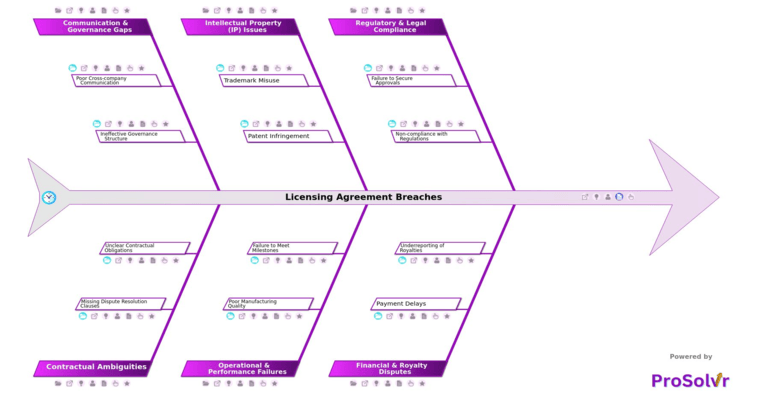
RCA of Licensing Agreement Breaches
Licensing agreement breaches occur when one or more parties fail to meet the contractual obligations defined within a pharmaceutical licensing arrangement. In an industry driven by strict regulations, shared intellectual property, and milestone-based partnerships, even minor lapses can escalate into major compliance and financial risks. These failures disrupt collaboration, slow drug development, and expose organizations to legal and reputational damage, making effective prevention and investigation critical for managing Licensing Agreement Breaches.
Common breach scenarios include delayed payments, inaccurate royalty reporting, regulatory non-compliance, or insufficient due diligence before licensing execution. Such breakdowns weaken partner trust, trigger regulatory scrutiny, and can directly impact patient access to life-saving therapies. Without a structured approach to understanding why these failures occur, organizations often resort to reactive fixes rather than sustainable solutions for licensing agreement breaches.
This is where structured Root Cause Analysis (RCA) becomes essential. A Gen-AI powered RCA approach built on fishbone diagrams and Six Sigma principles enables teams to move beyond surface-level symptoms and identify systemic weaknesses across regulatory, financial, IP, operational, and governance domains. By visually mapping contributing factors and uncovering hidden interdependencies, organizations can design effective corrective and preventive actions (CAPA) that address the true drivers of licensing agreement breaches.
ProSolvr applies this methodology through an intelligent, Gen-AI powered RCA platform that integrates fishbone diagram analysis with Six Sigma-aligned categorization. ProSolvr brings clarity, consistency, and speed to investigations to help pharmaceutical companies transform breach analysis from a manual, fragmented process into a repeatable, audit-ready capability. The result is stronger collaboration, improved compliance, and reduced recurrence of breaches pertaining to licensing agreements.
Who can learn from the Licensing Agreement Breaches template?
- Legal and Regulatory Teams: They can strengthen contract oversight and compliance practices, reducing the likelihood of disputes. The RCA helps them anticipate risks and address gaps in governance.
- Finance and Accounting Teams: They can use the insights to improve transparency, payment tracking, and royalty management. This ensures smoother financial relationships with partners.
- Business Development Teams: They gain a clearer understanding of partnership risks and can negotiate stronger agreements. RCA findings help them set realistic expectations and safeguards in licensing deals.
- Quality and Compliance Teams: They can align internal processes more closely with regulatory standards. The RCA highlights areas where compliance frameworks need reinforcement.
- Operations and Manufacturing Teams: They can recognize how performance failures impact licensing agreements. This helps them improve efficiency and reliability in meeting contractual obligations.
- Executive Leadership and Governance Boards: They can use RCA insights to refine decision-making and oversight mechanisms. This ensures strategic alignment and better risk management in collaborations.
Why use this template?
Once the root causes are identified, ProSolvr supports the development of targeted CAPA plans by organizations, ensuring actions are directly tied to the underlying problems rather than superficial fixes. This not only resolves the immediate breach but also drives long-term improvements in regulatory compliance, financial transparency, and operational governance across the pharmaceutical value chain.
Use ProSolvr by smartQED to understand the reasons behind licensing breaches and eliminate them for good.


