







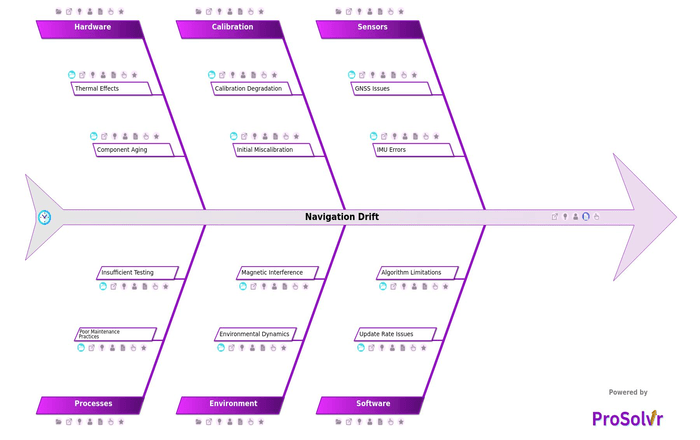
Navigation Drift Root Cause Analysis
Navigation drift in aircraft refers to the gradual deviation between the aircraft’s actual position and the position estimated by its navigation systems. Over time, small inaccuracies from onboard sensors, GNSS inputs, inertial measurement units, calibration settings, and software calculations can accumulate, causing the aircraft’s perceived location to shift away from its true position. This issue is especially critical during long-duration flights, oceanic routes, autonomous operations, and missions with limited external references, where precise navigation is essential for flight safety, operational efficiency, and regulatory compliance.
In the aerospace domain, navigation drift can create serious operational and safety challenges. GNSS issues such as poor satellite visibility and signal multipath can reduce positional accuracy, while IMU errors such as accelerometer noise and gyroscope bias may compound over time. Software-related factors, including timing synchronization errors, low refresh rates, weak sensor fusion tuning, and uncompensated drift models, can further worsen the problem. If not addressed, navigation drift may contribute to route deviations, increased fuel consumption, reduced mission accuracy, loss of separation risk, and higher pilot or operator workload.
After a navigation drift incident occurs, a structured Root Cause Analysis becomes essential to prevent recurrence. A Gen-AI powered RCA using a fishbone diagram and guided by Six Sigma principles helps teams systematically identify and organize contributing factors across sensors, software, calibration, environment, hardware, and maintenance processes. This approach separates symptoms from root causes and supports well-defined Corrective, Preventive, and Investigative Actions.
A root cause analysis application like ProSolvr can significantly enhance navigation drift investigations by combining fishbone driven RCA with Gen-AI capabilities. ProSolvr helps aerospace teams map interconnected causes, prioritize the most critical contributors, and convert findings into actionable CAPA plans. This enables stronger corrective actions, more effective preventive strategies, and continuous improvement in navigation system reliability.
Who can learn from the Navigation Drift template?
- Aerospace and Navigation System Engineers:They can understand how sensor issues, software limitations, calibration errors, and hardware aging contribute to navigation drift, enabling improvements in system design, architecture, and sensor integration.
- Avionics Software Developers: Developers can learn how update rate issues, timing synchronization errors, and algorithm limitations affect navigation accuracy, helping them refine sensor fusion logic and navigation algorithms.
- Calibration and Test Engineers: This group can gain insights into the effects of initial miscalibration, calibration degradation, and environmental influences, allowing them to strengthen calibration procedures and validation methods.
- Maintenance and Reliability Teams: Maintenance personnel can see how poor maintenance practices, delayed firmware updates, and skipped recalibration cycles lead to navigation drift, supporting stronger preventive and predictive maintenance programs.
- Quality Assurance and Verification Teams: QA teams can use the RCA to identify testing gaps such as lack of long-duration testing and limited scenario coverage, and enhance overall verification and validation strategies.
- Program Managers and Systems Engineers: They can leverage the RCA to understand cross-functional dependencies across hardware, software, environmental, and process factors, supporting better decision-making, risk management, and corrective action planning.
Why use this template?
ProSolvr helps teams map relationships between various causes. By presenting these causes in a structured and intuitive manner, the platform supports collaborative analysis and ensures that CAPA plans address systemic weaknesses rather than isolated failures. This leads to stronger corrective actions, more effective preventive strategies, and continuous improvement in aerospace navigation system reliability.
Use ProSolvr by smartQED to ensure safer skies and reduce liabilities in the aerospace domain.
Curated from community experience and public sources:


