







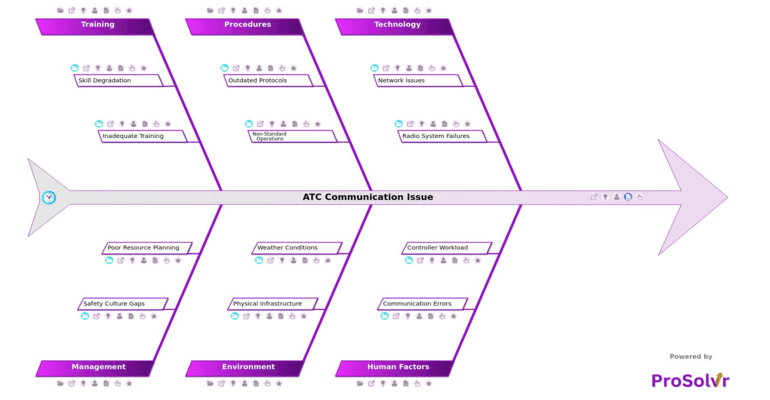
ATC Communication Issue Root Cause Analysis
An ATC communication issue refers to any breakdown, delay, distortion, or misunderstanding in communication between Air Traffic Control and pilots, or among controllers themselves. Clear and timely communication is essential for aircraft separation, navigation, and overall flight safety. When communication fails, the consequences can include incorrect clearances, delayed instructions, runway incursions, or loss of situational awareness. In high traffic airspace, even a brief disruption can escalate into serious operational risk.
ATC Communication Issues often arise from a combination of technical and human factors. Network issues, radio system failures, or degraded voice and data transmission can interrupt critical exchanges. Communication errors, ambiguous phraseology, and excessive controller workload increase the risk of misunderstanding. In a time sensitive aviation environment, small lapses can quickly compound and affect multiple aircraft simultaneously.
The aviation ecosystem is especially vulnerable due to high traffic density, complex procedures, and continuous coordination across systems and teams. Outdated protocols, non standard operations, infrastructure limitations, and adverse weather conditions can affect signal quality and reliability. Safety culture gaps, inadequate training, and weak resource planning may allow recurring vulnerabilities to persist. Without structured analysis, organizations may correct the immediate disruption but fail to address systemic weaknesses.
ProSolvr supports structured, AI powered Root Cause Analysis using visual Fishbone diagrams aligned with Six Sigma principles. It enables organizations to systematically analyze technology failures, human factors, procedural gaps, environmental influences, and management controls in one collaborative workspace. By clearly mapping contributing factors, ProSolvr strengthens CAPA development, improves compliance documentation, and reduces recurrence risk. This structured approach enhances communication reliability and strengthens overall aviation safety performance.
Who can learn from the ATC Communication Issue template?
- Air Traffic Controllers: To understand how technology failures, workload, communication issues, and environmental factors can escalate operational risks and how structured responses can mitigate impact.
- ATC Technical & Maintenance Engineers: To identify electrical, network, radio, and infrastructure-related weaknesses and improve maintenance, inspection, and upgrade practices.
- Safety & Quality Assurance Teams: To use the RCA findings for incident investigation, CAPA development, and strengthening safety management systems.
- Training & Human Factors Specialists: To improve recurrent training, simulation design, and competency management based on identified skill and communication gaps.
- Operations & Procedure Designers: To update protocols, standardize operations, and ensure alignment with international standards and real-world failure scenarios.
- Senior Management & Resource Planners: To make informed decisions on safety culture, staffing, budgeting, and long-term investment in resilient systems and infrastructure.
Why use this template?
ProSolvr helps teams collaboratively break down complex ATC communication issues into manageable cause categories, ensuring that critical factors are not overlooked. By guiding users through a disciplined RCA workflow, the application supports consistent CAPA development and helps organizations translate lessons learned into sustainable improvements. In the aerospace domain, such structured analysis strengthens safety outcomes by ensuring that communication failures are addressed at their root rather than through isolated, short-term fixes.
Use ProSolvr by smartQED to successfully eradicate issues that result in poor ATC communication for enhanced safety in aerospace domain.
Curated from community experience and public sources:


