







Landing Gear Failure Root Cause Analysis
Landing Gear Failure is one of the most critical safety events in aviation. When the landing gear system fails to deploy, retract, or lock correctly, the consequences can include hard landings, runway excursions, aircraft damage, and significant operational disruption. Beyond safety risks, such failures can trigger regulatory scrutiny, costly repairs, and loss of operational confidence.
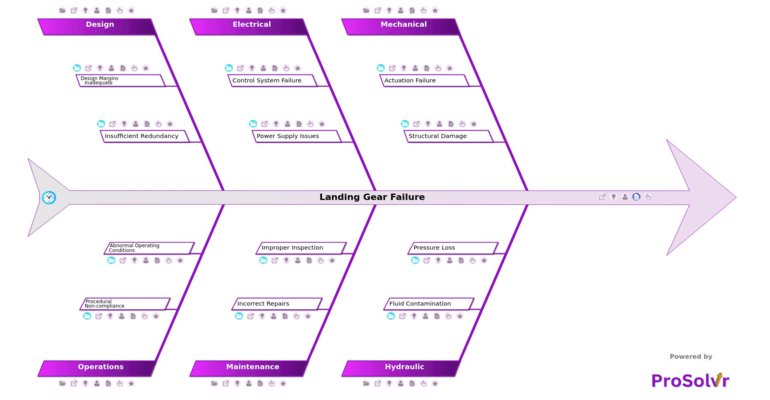
Landing Gear Failure rarely results from a single fault. Mechanical issues such as Actuation Failure, worn actuators, or jammed mechanisms may combine with Structural Damage caused by corrosion or fatigue cracks. Hydraulic problems like fluid contamination, moisture ingress, debris in fluid, pressure loss, pump failure, or hydraulic leaks can reduce system responsiveness. Electrical failures including control system failure, sensor signal loss, faulty relays, power supply issues, blown circuit breakers, or wiring faults further complicate diagnosis. Maintenance gaps, improper inspections, inadequate design margins, and abnormal operating conditions such as overweight landings or hard landings often amplify the risk.
The real challenge begins after the incident. Fixing a damaged component does not eliminate the underlying weakness. Without structured Root Cause Analysis, organizations risk repeat Landing Gear Failure events, increased audit findings, and recurring downtime. Complex interactions between Mechanical, Hydraulic, Electrical, Maintenance, Design, and Operational factors require a disciplined, system level investigation approach.
ProSolvr enables structured, AI powered Root Cause Analysis using visual Fishbone diagrams aligned with Six Sigma principles. It helps teams clearly map cause and effect relationships, standardize investigations, strengthen CAPA documentation, and reduce recurrence risk. By turning complex Landing Gear Failure investigations into a clear and collaborative process, ProSolvr supports safer operations and stronger long term aviation reliability.
Who can learn from the Landing Gear Failure template?
- Aircraft Maintenance Technicians and Engineers: They can understand how incorrect repairs, improper inspections, and missed defects contribute to landing gear failures, enabling improvements in maintenance quality, documentation accuracy, and regulatory compliance.
- Aerospace Design Engineers: They can gain insights into issues such as inadequate design margins, insufficient redundancy, and material selection challenges, helping strengthen future landing gear designs and structural robustness.
- Flight Operations and Pilots: Operational teams can recognize how procedural non-compliance, delayed gear extension, and abnormal operating conditions such as hard or overweight landings affect landing gear reliability and operational safety.
- Quality Assurance and Safety Teams: Safety and QA professionals can use the RCA to uncover systemic weaknesses across mechanical, hydraulic, electrical, and maintenance domains, supporting effective corrective and preventive action initiatives.
- Reliability and Systems Engineers: These teams can evaluate recurring failure modes such as actuation failures, hydraulic pressure loss, and control system malfunctions to enhance reliability engineering practices and failure prevention strategies.
- Training and Compliance Teams: Training professionals can leverage RCA findings to address skill gaps, improve inspection standards, reinforce procedural adherence, and update training programs based on identified root causes.
Why use this template?
ProSolvr helps teams visualize how various factors contribute to landing gear failure. By clearly mapping these relationships, the platform supports structured discussions, consensus-building, and the development of robust CAPA plans. This ensures that corrective actions go beyond immediate fixes and drive long-term improvements in design practices, maintenance procedures, and operational discipline across the aerospace organization.
Use ProSolvr by smartQED to systematically root out problems in aerospace domain.
Curated from community experience and public sources:


