






ProSolvr logo

Resolve problems, permanently

Root Cause Analysis of Cabin Pressure Fluctuation

Cabin Pressure Fluctuation Root Cause Analysis

Cabin pressure fluctuation is a critical aviation safety and compliance risk that refers to unexpected changes in cabin air pressure during flight. At high altitude, stable cabin pressure is essential for passenger safety and crew performance. Even minor instability can trigger discomfort, safety alerts, emergency procedures, and regulatory scrutiny. For Quality Heads, cabin pressure events represent not just a technical issue but a compliance and reliability risk.

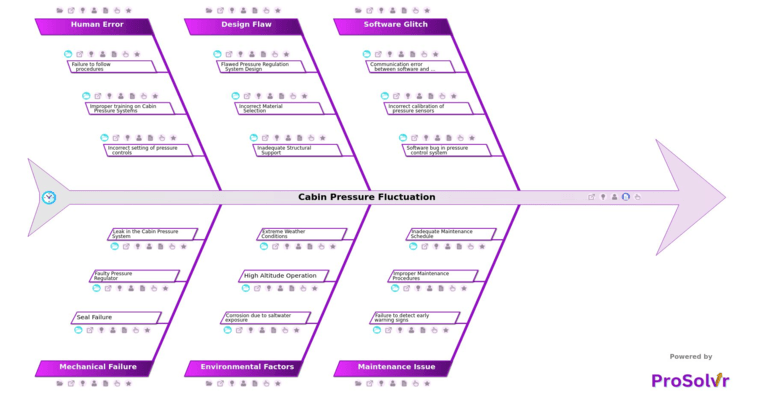
Cabin pressure fluctuation often results from multiple interconnected failures. These may include a Software Glitch, communication error between software and hardware, or a software bug in the pressure control system. Incorrect calibration of pressure sensors or calibration performed using outdated reference standards can distort system readings. Maintenance Issues such as failure to detect early warning signs, inadequate trend analysis of pressure fluctuation data, or improper maintenance procedures increase exposure. Design Flaws including lack of redundancy in pressure control components, incorrect material selection, or inadequate structural support further weaken system resilience. Mechanical Failure such as seal failure, faulty pressure regulator behavior, or leaks in the cabin pressure system can escalate the risk.

Many organizations fix the visible fault but miss the systemic cause. Human Error such as failure to follow procedures, improper training on cabin pressure systems, or misinterpretation of cockpit pressure indicators is often treated as an isolated mistake. Environmental factors like corrosion due to saltwater exposure or extreme weather conditions may be overlooked. Without structured Root Cause Analysis, recurring Cabin Pressure Fluctuation incidents remain unresolved. This increases audit findings, operational disruptions, and long term quality risk.

ProSolvr delivers structured, AI powered Root Cause Analysis through visual Fishbone diagrams aligned with Six Sigma principles. Quality leaders can clearly map technical failures, maintenance gaps, design weaknesses, environmental factors, and human errors within a single collaborative workspace. The platform strengthens CAPA management, improves compliance documentation, and accelerates cross functional investigations. With ProSolvr, teams establish a disciplined, standardized approach to preventing repeat Cabin Pressure Fluctuation incidents while enhancing regulatory compliance and aviation safety performance.

Cabin Pressure Fluctuation

    • Software Glitch
      • Communication error between software and hardware
        • Incompatible software update with legacy hardware interfaces
      • Incorrect calibration of pressure sensors
        • Calibration performed using outdated reference standards
      • Software bug in pressure control system
        • Incomplete testing of edge cases during software validation
    • Maintenance Issue
      • Failure to detect early warning signs
        • Inadequate trend analysis of pressure fluctuation data
      • Improper Maintenance Procedures
        • Maintenance SOPs not updated after system modifications
      • Inadequate Maintenance Schedule
        • Extended inspection intervals due to operational pressures
    • Design Flaw
      • Flawed Pressure Regulation System Design
        • Lack of redundancy in pressure control components
      • Incorrect Material Selection
        • Material not rated for cyclic pressure fatigue
      • Inadequate Structural Support
        • Insufficient reinforcement around pressure vessel joints
    • Environmental Factors
      • Corrosion due to saltwater exposure
        • Insufficient corrosion-resistant coating applied
      • High Altitude Operation
        • System operating beyond validated altitude limits
      • Extreme Weather Conditions
        • Pressure system exposed to rapid temperature gradients
    • Human Error
      • Failure to follow procedures
        • Procedural steps bypassed to save turnaround time
      • Improper training on Cabin Pressure Systems
        • Training focused on theory with limited hands-on practice
      • Incorrect setting of pressure controls
        • Misinterpretation of cockpit pressure indicators
    • Mechanical Failure
      • Seal Failure
        • Seal degradation due to aging and thermal cycling
      • Faulty Pressure Regulator
        • Internal valve sticking due to particulate contamination
      • Leak in the Cabin Pressure System
        • Micro-cracks developed at welded joints over time

Suggested Actions Checklist

Here are some corrective actions, preventive actions and investigative actions that organizations may find useful:

    • Software Glitch
      • Communication error between software and hardware
        • Corrective Actions:
          • Roll back or patch the software to restore stable communication with existing hardware interfaces.
        • Preventive Actions:
          • Enforce compatibility checks and interface validation before deploying any software updates.
        • Investigative Actions:
          • Review software–hardware interaction logs to identify failure points in communication protocols.
      • Incorrect calibration of pressure sensors
        • Corrective Actions:
          • Recalibrate all affected pressure sensors using current approved calibration standards.
        • Preventive Actions:
          • Establish a controlled calibration program with periodic verification against updated standards.
        • Investigative Actions:
          • Audit calibration records to determine when and how incorrect calibration was introduced.
      • Software bug in pressure control system
        • Corrective Actions:
          • Fix the identified software bug and deploy a validated software update.
        • Preventive Actions:
          • Strengthen software validation procedures with structured verification and sign-off checkpoints.
        • Investigative Actions:
          • Conduct a root-level software review to trace how the bug bypassed validation controls.
    • Maintenance Issue
      • Failure to detect early warning signs
        • Corrective Actions:
          • Immediately review historical system performance indicators and address any overlooked anomalies.
        • Preventive Actions:
          • Implement mandatory periodic review checkpoints for system health indicators.
        • Investigative Actions:
          • Examine maintenance monitoring practices to identify gaps in early warning detection.
      • Improper Maintenance Procedures
        • Corrective Actions:
          • Update and reissue maintenance procedures aligned with the current system configuration.
        • Preventive Actions:
          • Introduce a formal change-management process linking system modifications to SOP updates.
        • Investigative Actions:
          • Review procedural revision history to identify why updates were not incorporated.
      • Inadequate Maintenance Schedule
        • Corrective Actions:
          • Perform immediate inspections on systems that exceeded recommended maintenance intervals.
        • Preventive Actions:
          • Redefine maintenance schedules based on risk and criticality rather than operational convenience.
        • Investigative Actions:
          • Analyze maintenance planning decisions to identify drivers behind extended inspection intervals.
    • Design Flaw
      • Flawed Pressure Regulation System Design
        • Corrective Actions:
          • Implement design modifications to stabilize pressure regulation performance.
        • Preventive Actions:
          • Strengthen design review and approval processes with cross-functional technical input.
        • Investigative Actions:
          • Re-evaluate original design assumptions against actual operational conditions.
      • Incorrect Material Selection
        • Corrective Actions:
          • Replace non-compliant materials with those meeting operational stress requirements.
        • Preventive Actions:
          • Enforce stricter material qualification and approval criteria during design and sourcing.
        • Investigative Actions:
          • Review material selection decisions and validation documentation.
      • Inadequate Structural Support
        • Corrective Actions:
          • Reinforce affected structural areas to restore design integrity.
        • Preventive Actions:
          • Incorporate structural load and stress margin checks in future design validations.
        • Investigative Actions:
          • Analyze structural design calculations to identify underestimation of loads.
    • Environmental Factors
      • Corrosion due to saltwater exposure
        • Corrective Actions:
          • Remove corrosion-affected components and apply appropriate protective treatments.
        • Preventive Actions:
          • Introduce corrosion-resistant design and protection standards for exposed systems.
        • Investigative Actions:
          • Assess environmental exposure conditions against existing protection measures.
      • High Altitude Operation
        • Corrective Actions:
          • Restrict system operation to within validated altitude limits until redesign or revalidation.
        • Preventive Actions:
          • Clearly define and enforce operational limits through documentation and training.
        • Investigative Actions:
          • Review operational usage records to identify altitude exceedance patterns.
      • Extreme Weather Conditions
        • Corrective Actions:
          • Inspect and repair systems impacted by environmental stress.
        • Preventive Actions:
          • Enhance environmental robustness requirements during system qualification.
        • Investigative Actions:
          • Correlate failure events with environmental exposure conditions.
    • Human Error
      • Failure to follow procedures
        • Corrective Actions:
          • Reinforce adherence by retraining personnel on critical operating procedures.
        • Preventive Actions:
          • Introduce compliance checks and supervisory verification for critical tasks.
        • Investigative Actions:
          • Review operational practices to understand why procedures were bypassed.
      • Improper training on Cabin Pressure Systems
        • Corrective Actions:
          • Conduct focused hands-on retraining for relevant personnel.
        • Preventive Actions:
          • Redesign training programs to balance theory with practical system exposure.
        • Investigative Actions:
          • Evaluate training effectiveness and competency assessment results.
      • Incorrect setting of pressure controls
        • Corrective Actions:
          • Correct system settings and verify normal operation.
        • Preventive Actions:
          • Improve control labeling and procedural guidance to reduce interpretation errors.
        • Investigative Actions:
          • Analyze incident reports to identify patterns of control-setting errors.
    • Mechanical Failure
      • Seal Failure
        • Corrective Actions:
          • Replace failed seals with approved components meeting operational requirements.
        • Preventive Actions:
          • Define seal replacement intervals based on service life and operating conditions.
        • Investigative Actions:
          • Examine removed seals to determine failure characteristics and contributing factors.
      • Faulty Pressure Regulator
        • Corrective Actions:
          • Repair or replace the faulty pressure regulator.
        • Preventive Actions:
          • Implement stricter cleanliness and component handling controls.
        • Investigative Actions:
          • Inspect failed regulators to identify internal failure mechanisms.
      • Leak in the Cabin Pressure System
        • Corrective Actions:
          • Repair identified leaks and restore system integrity.
        • Preventive Actions:
          • Introduce enhanced inspection and integrity testing during maintenance cycles.
        • Investigative Actions:
          • Review failure history to determine recurring leak locations or patterns.
 

Who can learn from the Cabin Pressure Fluctuation template?

  • Aerospace Engineers: They can learn how design decisions, material selection, and system redundancy gaps contribute to cabin pressure fluctuations, and apply these insights to enhance robustness and safety in future aircraft designs.
  • Maintenance and Engineering Support Teams: These teams can understand how maintenance procedures, inspection intervals, and gaps in early warning detection affect pressurization system reliability, enabling more proactive and effective maintenance practices.
  • Flight Crew and Operations Personnel: Pilots and operations staff can gain awareness of how procedural compliance, training quality, and correct system handling directly influence cabin pressure stability and in-flight safety.
  • Quality and Safety Management Teams: Safety and quality professionals can use the RCA to identify systemic weaknesses across design, operations, and maintenance, strengthening regulatory compliance, risk management, and CAPA programs.
  • Training and Competency Development Teams: Training groups can identify where knowledge and skill gaps exist and design more targeted, role-specific training programs to reduce human error and improve system handling.
  • Leadership and Program Management: Managers and decision-makers can understand cross-functional dependencies and resource constraints, helping them prioritize investments in safety, process improvement, and preventive initiatives.

Why use this template?

ProSolvr helps teams map complex cause-and-effect relationships clearly, showing how factors interact within the broader system. By guiding users through a structured RCA workflow, ProSolvr supports consistent analysis, clearer documentation, and stronger CAPA development. This enables aerospace organizations to move beyond symptom-fixing and toward building more resilient cabin pressurization systems and operational processes.

Use ProSolvr by smartQED to eradicate problems related to cabin pressure to ensure safety and better flight experience.

Curated from community experience and public sources:

  • https://www.lot.com/in/en/explore/inspirations/aviation-trivia/pressure-in-the-plane
  • https://skybrary.aero/articles/loss-cabin-pressurisation
