






ProSolvr logo

Resolve problems, permanently

Root Cause Analysis of Loss of Flight Control

Loss of Flight Control Root Cause Analysis

Loss of flight control is an aviation safety condition in which pilots are unable to maintain or restore control of an aircraft’s attitude, trajectory, or speed using normal flight control systems. It can occur during takeoff, cruise, or landing and often escalates rapidly into a serious safety event. Because aircraft operate in highly dynamic environments, even brief loss of control can result in stalls, structural overloads, or complete loss of the aircraft, making it one of the most significant contributors to major aviation accidents.

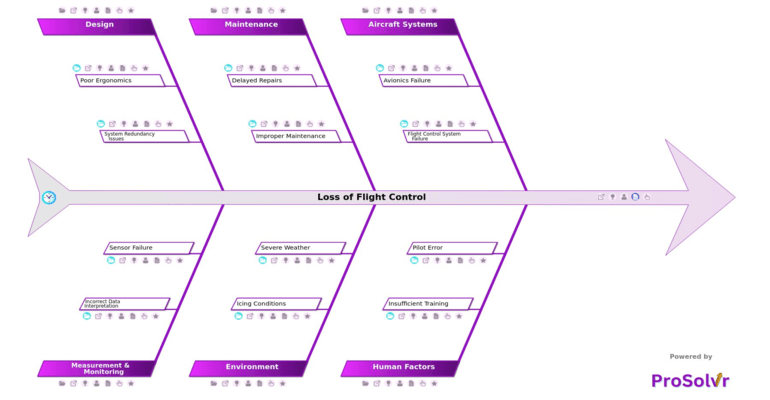
Loss of flight control frequently originates from failures in aircraft systems and measurement functions. Avionics failures such as flight computer software errors can produce incorrect control logic, while flight control system failures like actuator malfunctions can prevent pilot commands from being carried out. Sensor failures including faulty airspeed sensors and misleading cockpit indications can cause incorrect data interpretation, reducing situational awareness and increasing the risk of inappropriate control inputs during critical moments.

Human factors and maintenance practices are also major contributors to loss of flight control events. Insufficient training, especially limited simulator exposure, can leave pilots unprepared to manage abnormal flight conditions. Pilot error such as improper control input becomes more likely under stress and high workload. Maintenance issues including delayed repairs, deferred maintenance items, and incomplete inspection procedures can allow latent defects to persist, weakening system reliability and reducing recovery margins.

Environmental conditions and aircraft design characteristics often trigger or intensify loss of flight control scenarios. Icing conditions caused by inadequate de icing can significantly degrade aircraft performance, while severe weather such as turbulence or wind shear can rapidly destabilize the aircraft. Design factors including poor ergonomics, confusing cockpit interfaces, and limited system redundancy increase vulnerability when failures occur.

A structured Root Cause Analysis using a Gen AI powered fishbone approach within ProSolvr helps aerospace organizations identify these interconnected causes and implement effective corrective and preventive actions that improve long term flight safety.

Loss of Flight Control

    • Aircraft Systems
      • Avionics Failure
        • Flight computer software error
      • Flight Control System Failure
        • Actuator malfunction
    • Human Factors
      • Insufficient Training
        • Inadequate simulator exposure
      • Pilot Error
        • Improper control input
    • Maintenance
      • Delayed Repairs
        • Deferred maintenance items
      • Improper Maintenance
        • Incomplete inspection procedures
    • Environment
      • Icing Conditions
        • Inadequate de-icing
      • Severe Weather
        • Turbulence or wind shear
    • Design
      • Poor Ergonomics
        • Confusing cockpit interface
      • System Redundancy Issues
        • Single-point failure
    • Measurement & Monitoring
      • Incorrect Data Interpretation
        • Misleading cockpit indications
      • Sensor Failure
        • Faulty airspeed sensor

Suggested Actions Checklist

Here are some corrective actions, preventive actions and investigative actions that organizations may find useful:

    • Aircraft Systems
      • Avionics Failure
        • Corrective Actions:
          • Isolate the affected avionics circuit and replace damaged wiring or components caused by the short circuit.
        • Preventive Actions:
          • Introduce enhanced circuit protection and insulation standards for avionics wiring bundles.
        • Investigative Actions:
          • Analyze failure reports and wiring diagrams to determine how the short circuit propagated within avionics systems.
      • Flight Control System Failure
        • Corrective Actions:
          • Restore flight control system functionality by repairing or replacing short-circuited electrical control paths.
        • Preventive Actions:
          • Improve electrical segregation between flight control circuits and other power systems.
        • Investigative Actions:
          • Examine electrical load paths to identify how the short circuit impacted flight control actuation signals.
    • Human Factors
      • Insufficient Training
        • Corrective Actions:
          • Conduct targeted refresher training on recognizing and responding to electrical short-circuit indications.
        • Preventive Actions:
          • Incorporate electrical failure and short-circuit scenarios into standard training curricula.
        • Investigative Actions:
          • Review training records to assess gaps related to electrical fault management.
      • Pilot Error
        • Corrective Actions:
          • Reinforce correct checklist usage during electrical anomalies caused by short circuits.
        • Preventive Actions:
          • Standardize cockpit procedures emphasizing early identification of electrical faults.
        • Investigative Actions:
          • Review cockpit voice and flight data records to evaluate pilot response to the short-circuit event.
    • Maintenance
      • Delayed Repairs
        • Corrective Actions:
          • Immediately address deferred electrical discrepancies linked to short-circuit risks.
        • Preventive Actions:
          • Enforce stricter limits on deferring electrical system-related maintenance items.
        • Investigative Actions:
          • Review maintenance deferral logs to identify patterns contributing to unresolved short-circuit hazards.
      • Improper Maintenance
        • Corrective Actions:
          • Rework electrical installations where improper maintenance may have caused insulation damage or loose connections.
        • Preventive Actions:
          • Strengthen maintenance SOPs for electrical inspections and reassembly.
        • Investigative Actions:
          • Audit recent maintenance activities to determine whether procedures contributed to the short circuit.
    • Environment
      • Icing Conditions
        • Corrective Actions:
          • Inspect and repair electrical components affected by moisture ingress leading to short circuits.
        • Preventive Actions:
          • Enhance sealing and environmental protection of electrical systems exposed to icing conditions.
        • Investigative Actions:
          • Assess environmental exposure reports to correlate icing conditions with electrical failures.
      • Severe Weather
        • Corrective Actions:
          • Replace weather-damaged electrical components impacted by short circuits.
        • Preventive Actions:
          • Upgrade weather-hardening measures for wiring and connectors in exposed zones.
        • Investigative Actions:
          • Review weather data and system fault timelines to determine the role of severe conditions in the short circuit.
    • Design
      • Poor Ergonomics
        • Corrective Actions:
          • Modify cockpit layouts to clearly distinguish electrical controls affected during short-circuit events.
        • Preventive Actions:
          • Apply human-centered design principles to reduce confusion during electrical failures.
        • Investigative Actions:
          • Collect pilot feedback to assess how ergonomic design influenced response to the short circuit.
      • System Redundancy Issues
        • Corrective Actions:
          • Restore system functionality by rerouting power through unaffected redundant circuits.
        • Preventive Actions:
          • Redesign electrical architectures to eliminate single-point vulnerabilities to short circuits.
        • Investigative Actions:
          • Conduct a failure mode review to identify where redundancy failed during the incident.
    • Measurement & Monitoring
      • Incorrect Data Interpretation
        • Corrective Actions:
          • Clarify cockpit indications following short-circuit events through updated procedures or alerts.
        • Preventive Actions:
          • Improve indication logic to clearly differentiate short-circuit-related faults from other failures.
        • Investigative Actions:
          • Analyze system indication behavior during the incident to identify sources of misinterpretation.
      • Sensor Failure
        • Corrective Actions:
          • Replace sensors damaged or disabled due to the electrical short circuit.
        • Preventive Actions:
          • Improve electrical isolation and surge protection for critical sensors.
        • Investigative Actions:
          • Examine sensor failure data to determine susceptibility to short-circuit conditions.
 

Who can learn from the Loss of Flight Control template?

  • Flight Operations Teams They can understand how operational decisions, human factors, and environmental conditions contribute to loss of flight control, helping improve standard operating procedures and in-flight decision-making.
  • Engineering and Design Teams These teams can learn how design limitations, system redundancy issues, and ergonomics influence controllability, enabling safer and more resilient aircraft designs.
  • Maintenance and Reliability Teams Maintenance personnel can gain insights into how delayed or improper maintenance contributes to control failures, strengthening inspection practices and maintenance planning.
  • Training and Competency Development Teams Training groups can use the RCA to identify gaps in pilot and crew preparedness, improving simulator programs, recurrent training, and skill reinforcement.
  • Safety and Risk Management Teams Safety professionals can learn how multiple technical and human causes interact, helping them enhance hazard identification, safety management systems, and preventive strategies.
  • Management and Leadership Teams Leaders can understand systemic process gaps revealed by the RCA, supporting better resource allocation, policy updates, and long-term safety culture improvements.

Why use this template?

A root cause analysis application like ProSolvr, which leverages fishbone diagrams and GEN-AI capabilities, can significantly enhance this analysis and problem-solving process. ProSolvr helps teams structure complex loss-of-flight-control scenarios and visually map relationships between various causes. By guiding users through a standardized RCA methodology, ProSolvr supports thorough documentation, clearer decision-making, and stronger CAPA development. This enables aerospace organizations to transform a serious incident into a learning opportunity that drives safer designs, better training, and more robust operational practices.

Use ProSolvr by smartQED to eliminate loss of flight control to make the skies safer for everyone.

Curated from community experience and public sources:

  • https://skybrary.aero/articles/loss-control
  • https://www.iata.org/en/programs/safety/operational-safety/loss-of-control-inflight/
