







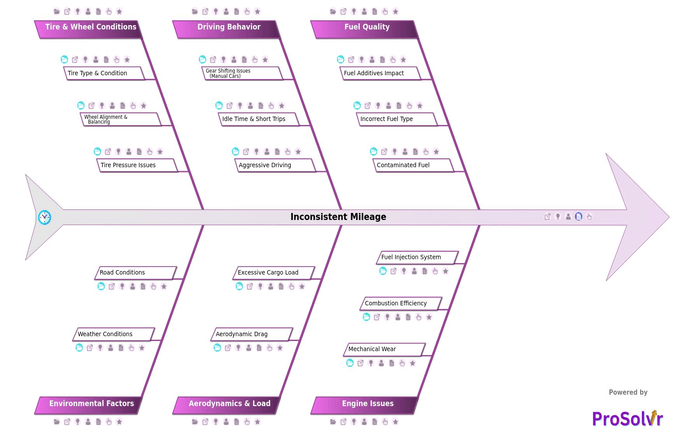
Root Cause Analysis of Inconsistent Mileage
Inconsistent mileage is a persistent challenge in the automotive industry, affecting fuel efficiency, operational costs, and customer satisfaction. Variability in fuel quality, engine performance, aerodynamics, and driving behavior can lead to unexpected deviations in fuel economy. Factors such as fuel contamination, incorrect air-fuel ratio calibration, improper gear shifting, and aerodynamic inefficiencies often contribute to fluctuating mileage. Additionally, tire and wheel conditions, environmental factors, and excessive vehicle load can further impact fuel efficiency.
Manufacturing and operational challenges also play a role in mileage inconsistency. Mechanical wear in the engine, clogged fuel injectors, and misaligned wheels can lead to inefficient fuel consumption. Variability in fuel additives, ethanol blend issues, and poor storage conditions at fuel stations may also degrade fuel quality, affecting combustion efficiency. External conditions such as wind resistance, rough road surfaces, and extreme temperatures can further alter real-world fuel performance. These factors create a complex network of root causes that require a structured analysis to pinpoint the source of inconsistencies.
When mileage inconsistencies arise, conducting a structured Root Cause Analysis (RCA) using AI-powered fishbone diagrams is essential for systematically identifying contributing factors. ProSolvr’s AI-driven RCA application enables manufacturers and fleet operators to categorize causes across critical areas such as fuel quality, engine performance, aerodynamics, driving behavior, and environmental influences. By leveraging Six Sigma methodologies, ProSolvr helps eliminate guesswork and focus on data-driven problem resolution after an issue has been detected.
Using ProSolvr’s AI-powered fishbone diagrams, teams can visually map interdependencies between mechanical, environmental, and operational factors affecting mileage. This structured RCA approach allows manufacturers and fleet managers to standardize issue resolution, enhance fuel efficiency, and implement corrective actions effectively. With ProSolvr, the automotive industry can reduce inefficiencies, optimize fuel usage, and improve overall vehicle performance, ensuring cost-effective and reliable operations.
Who can use the Inconsistent Mileage template?
- Fleet Managers & Logistics Companies: They need to optimize fuel efficiency across large vehicle fleets, reduce operational costs, and implement preventive maintenance strategies.
- Automobile Manufacturers & Engineers: Understanding mileage inconsistencies helps in vehicle design improvements, quality control, and refining fuel injection and combustion systems.
- Automobile Service & Maintenance Technicians: Mechanics can use the structured RCA approach to diagnose and fix issues related to fuel quality, engine performance, and tire conditions.
- Drivers & Driving Schools: Educating drivers on fuel-efficient driving techniques, such as proper gear shifting, avoiding excessive idling, and minimizing aerodynamic drag, can help improve mileage.
- Regulatory Bodies & Environmental Agencies: Organizations focusing on fuel efficiency standards, emissions control, and road infrastructure improvements can use this analysis to formulate better policies and regulations.
Why use this template?
By integrating Six Sigma methodologies with an intuitive fishbone diagram approach, ProSolvr aids in reducing inefficiencies, standardizing problem resolution, and preventing future occurrences of inconsistent mileage. This systematic approach helps manufacturers, fleet operators, and vehicle owners optimize fuel usage, enhance vehicle longevity, and improve overall operational efficiency in the automobile industry.
Use ProSolvr by smartQED to eliminate poor fuel efficiency and other issues in your automobile plant.


