







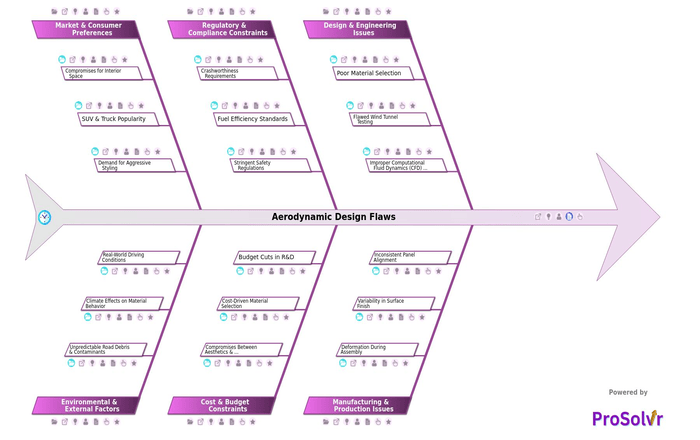
Root Cause Analysis of Aerodynamic Design Flaws
Aerodynamic design flaws in automobiles can significantly impact fuel efficiency, vehicle stability, and overall performance. These flaws occur when design, manufacturing, or regulatory constraints create excessive drag, reduce handling efficiency, or disrupt airflow. Common design and engineering issues include poor material selection, where deformation at high speeds or high surface roughness increases aerodynamic resistance. Similarly, flawed wind tunnel testing, such as boundary layer interference, incorrect scale models, or limited real-world testing, can result in inaccurate aerodynamic predictions, leading to unexpected performance issues in production vehicles.
Manufacturing and production challenges also contribute to aerodynamic inefficiencies. Deformation during assembly, caused by thermal expansion or stress-induced shape changes, can alter the intended airflow dynamics. Variability in surface finish, such as manufacturing tolerances, uneven paint thickness, or inconsistent panel alignment, further disrupts smooth airflow. Gaps between body panels due to poor quality control can introduce turbulence, reducing the vehicle’s aerodynamic efficiency. With ProSolvr’s AI-driven RCA tools, manufacturers can systematically trace these defects, visualizing their interdependencies and identifying the precise manufacturing processes contributing to aerodynamic inefficiencies.
Beyond engineering and production, regulatory and budget constraints often necessitate design compromises. Crashworthiness requirements and structural reinforcements can inadvertently increase drag, while fuel efficiency standards may force manufacturers to prioritize emissions over optimal aerodynamics. Additionally, cost-driven material selection, budget cuts in R&D, and fewer prototype iterations limit aerodynamic testing and optimization efforts. Market demands for SUVs and aggressive styling trends also lead to higher drag coefficients, as vehicle shapes prioritize aesthetics or interior space over streamlined performance.
When aerodynamic inefficiencies lead to performance issues or regulatory non-compliance, conducting a structured Root Cause Analysis (RCA) using ProSolvr enables manufacturers to systematically diagnose issues after they have occurred. ProSolvr’s AI-powered fishbone diagrams help teams analyze the root causes of aerodynamic failures, whether due to material deformation, flawed simulations, regulatory constraints, or production inconsistencies. By visualizing root causes and interdependencies, ProSolvr ensures that corrective actions are targeted and effective, helping manufacturers optimize designs while maintaining compliance and cost efficiency.
Who can use the Aerodynamic Design Flaws template?
- Automobile Engineers and Designers: Engineers working on vehicle performance, design, and development can gain insights into how aerodynamic principles affect vehicle efficiency, stability, and safety. Learning from the template helps them optimize vehicle shapes, materials, and manufacturing processes to reduce drag and improve fuel economy.
- Manufacturing Teams: Those involved in vehicle assembly and production can benefit from understanding the potential aerodynamic flaws that occur during manufacturing, such as deformation during assembly or variability in surface finish. They can use this knowledge to identify and correct issues early in the production line to ensure high-quality, aerodynamically efficient vehicles.
- Research and Development (R&D) Teams: R&D teams working on automotive technologies, including CFD analysis or wind tunnel testing, can apply the principles from the template to refine their testing procedures, models, and simulations. This knowledge helps ensure that prototypes are more accurate and aligned with real-world performance expectations.
- Regulatory Authorities and Safety Inspectors: Individuals involved in setting or enforcing automotive regulations, such as fuel efficiency standards, crashworthiness requirements, and safety regulations, can use the template to better understand how these rules impact aerodynamic design. This awareness helps them balance safety standards with performance optimization in vehicles.
- Automotive Industry Trainers and Educators: Trainers and educators who teach automotive engineering or design can use the aerodynamics template to educate students on the complex interplay of design, production, and regulation in vehicle aerodynamics. This helps build a comprehensive foundation for future professionals in the industry.
Why use this template?
A specialized root cause analysis application like ProSolvr, which employs fishbone diagrams for structured problem-solving, can significantly enhance the efficiency of identifying and addressing aerodynamic flaws. ProSolvr can help engineers visualize cause-effect relationships, ensuring a thorough investigation. By systematically breaking down each failure mode, ProSolvr enables companies to implement data-driven solutions, preventing costly rework and ensuring regulatory adherence. By identifying root causes and implementing CAPA, manufacturers can enhance vehicle efficiency, reduce compliance risks, and optimize production processes, ultimately improving both performance and profitability.
Use ProSolvr by smartQED for effectively resolving problems in your automotive plants.


