






ProSolvr logo

Resolve problems, permanently

Inadequate Sterilization Practices RCA: Root Cause Analysis Template

RCA of Inadequate Sterilization Practices

Inadequate sterilization practices in hospitals refer to failures in properly eliminating microorganisms from medical instruments, surfaces, and environments. These failures often stem from behavioral non-compliance, training gaps, weak processes, equipment issues, and ineffective management. When protocols are not followed consistently, even routine procedures can become high-risk for infection transmission. Behavioral non-compliance, such as bypassing SOP steps, and inadequate training make it difficult for staff to apply correct sterilization methods.

Process gaps further compound the problem. Absence of standardized SOPs, including outdated or poorly aligned guidelines and lack of clearly documented procedures, creates confusion. Improper sterilization execution, such as inadequate exposure time or incorrect selection of temperature and pressure, results in ineffective outcomes. These issues make routine procedures unsafe and increase the likelihood of infections, contributing to hospital-acquired infections (HAIs), longer hospital stays, and higher treatment costs.

Equipment and environmental factors also play a key role. Inadequate equipment maintenance, including lack of preventive maintenance programs and irregular inspections, reduces reliability. Sterilization equipment failures, such as calibration drift or autoclave malfunction, can directly compromise results. At the same time, high workloads and staff shortages often lead to rushed sterilization processes. Poor air quality, weak contamination control, and inadequate cleaning of sterilization areas further elevate infection risks and impact overall care quality.

Management gaps allow these issues to persist. Weak policy enforcement, including inconsistent supervision and lack of accountability, reduces control over sterilization practices. Inadequate monitoring and auditing, such as absence of compliance tracking and periodic reviews, limits visibility into recurring problems. For patients, the risks are severe, ranging from post-surgical infections and delayed recovery to life-threatening complications, especially in critical care settings.

Root Cause Analysis (RCA) helps identify underlying systemic failures across people, process, equipment, environment, and management, uncovering why gaps persist. A GenAI-powered application like ProSolvr enhances this process by organizing cause structures, identifying patterns, and enabling teams to prioritize high-impact interventions for better patient safety and healthcare quality.

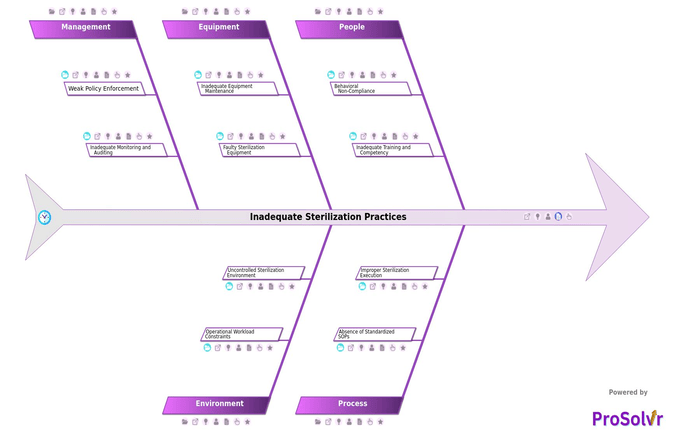
Inadequate Sterilization Practices

    • People
      • Behavioral Non-Compliance
        • Deliberate bypassing of sterilization SOP steps
        • Failure to adhere to aseptic handling protocols
      • Inadequate Training & Competency
        • Lack of structured training on sterilization protocols
        • Insufficient hands-on training for sterilization equipment
    • Process
      • Absence of Standardized SOPs
        • Outdated or non-aligned sterilization guidelines
        • Lack of clearly documented sterilization procedures
      • Improper Sterilization Execution
        • Inadequate exposure time during sterilization cycles
        • Incorrect selection of sterilization parameters (temperature/pressure)
    • Equipment
      • Inadequate Equipment Maintenance
        • Lack of preventive maintenance program
        • Irregular inspection and servicing schedules
      • Sterilization Equipment Failure
        • Calibration drift in sterilization instruments
        • Autoclave or sterilizer malfunction
    • Environment
      • Operational Workload Constraints
        • High workload leading to rushed sterilization processes
        • Staff shortages impacting compliance
      • Uncontrolled Sterilization Environment
        • Poor air quality and contamination control
        • Inadequate cleaning of sterilization areas
    • Management
      • Weak Policy Enforcement
        • Inconsistent supervision of sterilization practices
        • Absence of accountability for non-compliance
      • Inadequate Monitoring & Auditing
        • Lack of sterilization compliance tracking systems
        • Absence of periodic sterilization audits

Suggested Actions Checklist

Here are some corrective actions, preventive actions and investigative actions that organizations may find useful:

    • People
      • Behavioral Non-Compliance
        • Corrective Actions:
          • Reinforce immediate adherence to sterilization SOPs through mandatory compliance briefings and supervision.
        • Preventive Actions:
          • Establish accountability frameworks with defined roles and compliance-linked performance evaluations.
        • Investigative Actions:
          • Review incident reports and conduct behavioral audits to identify patterns of non-compliance.
      • Inadequate Training & Competency
        • Corrective Actions:
          • Conduct targeted retraining programs on sterilization protocols and equipment handling.
        • Preventive Actions:
          • Implement structured training programs with periodic competency assessments and certifications.
        • Investigative Actions:
          • Evaluate training records and skill gaps to identify deficiencies in staff competency.
    • Process
      • Absence of Standardized SOPs
        • Corrective Actions:
          • Develop and implement standardized, clearly documented sterilization SOPs across all units.
        • Preventive Actions:
          • Establish periodic SOP review and update mechanisms aligned with regulatory standards.
        • Investigative Actions:
          • Assess existing documentation practices to identify gaps and inconsistencies in SOP availability.
      • Improper Sterilization Execution
        • Corrective Actions:
          • Revalidate sterilization processes and ensure correct cycle parameters are followed.
        • Preventive Actions:
          • Introduce automated controls and checklists to ensure adherence to sterilization parameters.
        • Investigative Actions:
          • Analyze sterilization logs and deviation reports to identify recurring execution errors.
    • Equipment
      • Inadequate Equipment Maintenance
        • Corrective Actions:
          • Perform immediate servicing and maintenance of all sterilization equipment.
        • Preventive Actions:
          • Implement a preventive maintenance schedule with defined service intervals.
        • Investigative Actions:
          • Review maintenance logs to identify missed schedules or recurring equipment issues.
      • Sterilization Equipment Failure
        • Corrective Actions:
          • Repair or replace malfunctioning sterilization equipment and recalibrate instruments.
        • Preventive Actions:
          • Establish routine calibration and performance verification protocols.
        • Investigative Actions:
          • Conduct root cause analysis on equipment failure history and calibration records.
    • Environment
      • Operational Workload Constraints
        • Corrective Actions:
          • Redistribute workload and allocate additional staff to reduce process pressure.
        • Preventive Actions:
          • Implement workforce planning and staffing models aligned with operational demand.
        • Investigative Actions:
          • Analyze staffing patterns and workload data to identify bottlenecks and stress points.
      • Uncontrolled Sterilization Environment
        • Corrective Actions:
          • Clean and sanitize sterilization areas and restore environmental control measures.
        • Preventive Actions:
          • Implement strict environmental monitoring and cleaning schedules.
        • Investigative Actions:
          • Assess environmental monitoring data to trace sources of contamination.
    • Management
      • Weak Policy Enforcement
        • Corrective Actions:
          • Enforce compliance through stricter supervision and disciplinary actions where necessary.
        • Preventive Actions:
          • Develop governance frameworks with clear accountability and escalation mechanisms.
        • Investigative Actions:
          • Review supervision practices and policy adherence records to identify enforcement gaps.
      • Inadequate Monitoring & Auditing
        • Corrective Actions:
          • Initiate immediate audits and implement tracking systems for sterilization compliance.
        • Preventive Actions:
          • Establish periodic audit schedules with defined KPIs and compliance metrics.
        • Investigative Actions:
          • Evaluate historical audit data and monitoring systems to identify oversight gaps.
 

Who can learn from the Inadequate Sterilization Practices template?

  • Hospital Administrators and Management: They can understand gaps in policy enforcement, resource allocation, and accountability systems, helping them strengthen governance and ensure strict adherence to sterilization standards.
  • Doctors And Surgeons: They can better appreciate the importance of sterilized instruments and aseptic practices, reducing the risk of infections during procedures and improving patient outcomes.
  • Nursing Staff and Clinical Support Teams: They can enhance compliance with sterilization protocols in day-to-day activities, especially in handling instruments and maintaining sterile environments.
  • Sterilization Technicians and CSSD Staff: They can improve their technical understanding of sterilization processes, equipment handling, and monitoring critical parameters like time, temperature, and pressure.
  • Infection Control and Quality Assurance Teams: They can use the RCA insights to design stronger audit systems, improve monitoring mechanisms, and implement effective CAPA strategies to minimize infection risks.

Why use this template?

ProSolvr can support continuous improvement by standardizing RCA frameworks, ensuring consistency across departments. Its AI capabilities can assist in refining causes, reducing duplication, and improving clarity, which is especially useful in complex environments like hospitals. This ultimately leads to more reliable sterilization processes, improved patient safety, and stronger compliance with healthcare standards.

Use ProSolvr by smartQED to ensure that causes related to improper sterilization are ruled out for improved patient safety.

Curated from community experience and public sources:

  • https://shea-online.org/poor-cleaning-can-jeopardize-sterilization-of-medical-tools/
  • https://www.sciencedirect.com/science/article/abs/pii/S0196655325006789?dgcid=rss_sd_all
