







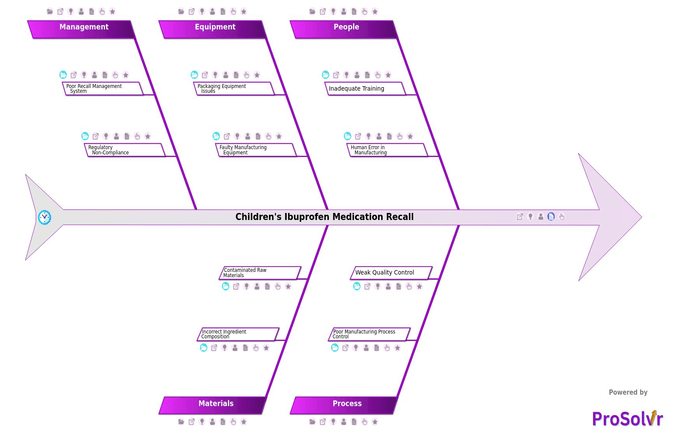
RCA of Children's Ibuprofen Medication Recall
In March 2026, Strides Pharma Inc. voluntarily recalled 89,592 bottles of Children’s Ibuprofen Oral Suspension (100 mg per 5 mL), manufactured for Taro Pharmaceuticals U.S.A., Inc., after consumer complaints of visible contamination. The recall involved lots 7261973A and 7261974A, expiring on January 31, 2027, and was classified by the U.S. Food and Drug Administration as a Class II recall, meaning the product could cause temporary or medically reversible health effects. Parents and caregivers were advised to immediately discontinue use of the affected medicine.
The Children’s Ibuprofen Medication Recall highlights the importance of strong pharmaceutical quality systems and evidence based root cause analysis. Consumer complaints about visible foreign material may require manufacturers to examine several possible causes, including inadequate training, insufficient quality awareness, lack of GMP training, and human error in manufacturing. Investigators should review training records, interview employees, check production activities, and confirm whether operators followed approved procedures. Immediate corrective actions may include retraining affected personnel, verifying their competency, quarantining affected batches, and introducing independent checks for critical manufacturing steps.
The investigation should also examine poor manufacturing process control, lack of validation, process deviations not recorded, and weak quality control. These issues could contribute to a failure to detect impurities, inadequate batch testing, incorrect dosage formulation, or other product quality problems. Investigation teams should review process parameters, batch records, validation documents, deviation reports, laboratory results, and testing methods. Corrective and preventive actions may include revalidating the process, strengthening batch testing, improving deviation reporting, updating quality control procedures, and introducing routine process monitoring.
Incidents such as this demonstrate why root cause analysis (RCA) is indispensable within pharmaceutical manufacturing. A structured RCA enables manufacturers to move beyond symptom correction and identify the true source of failure, leading to effective corrective and preventive actions (CAPA). By addressing systemic weaknesses instead of isolated defects, organizations can strengthen quality systems, improve process consistency, enhance regulatory compliance, reduce future recalls, and ultimately protect patient safety, particularly for vulnerable populations such as children.
Modern GenAI-powered RCA platforms such as ProSolvr can make these investigations faster, more structured, and more comprehensive. Using interactive fishbone (Ishikawa) diagrams aligned with Six Sigma principles, ProSolvr helps investigation teams systematically organize potential causes across various categories, while enabling deeper "5 Whys" exploration to reach the true root causes.
Who can learn from the Children's Ibuprofen Medication Recall template?
- Pharmaceutical Manufacturing Companies: Pharmaceutical manufacturers can use the RCA to identify the root causes of contamination events, strengthen manufacturing processes, and reduce the likelihood of future product recalls through systematic process improvements.
- Quality Assurance (QA) and Quality Control (QC) Teams: QA and QC teams can leverage the RCA to investigate quality failures, improve inspection and testing procedures, and implement effective corrective and preventive actions (CAPA) to enhance product quality.
- Regulatory Affairs and Compliance Professionals: Regulatory and compliance teams can use the RCA to support FDA and GMP compliance, strengthen investigation documentation, and ensure corrective actions meet regulatory expectations.
- Contract Manufacturing Organizations (CMOs) and Pharmaceutical Suppliers: CMOs and suppliers can apply the RCA to evaluate supplier quality systems, raw material controls, and manufacturing practices that may contribute to contamination risks, improving supply chain reliability.
- Pharmaceutical Operations and Continuous Improvement Teams: Operations and continuous improvement teams can use structured root cause analysis to optimize manufacturing processes, reduce operational risks, and enhance overall product quality and patient safety.
Why use this template?
Instead of relying solely on brainstorming or fragmented documentation, this ProSolvr RCA template assists teams in developing logical cause hierarchies, uncovering overlooked contributing factors, and generating well-structured corrective, preventive, and investigative actions. This enables pharmaceutical manufacturers to conduct consistent, evidence-based investigations that improve CAPA effectiveness, strengthen quality management systems, and reduce the likelihood of similar contamination incidents occurring in future production batches.
Use ProSolvr by smartQED to eliminate incidents of medicine contamination in your plant for the ultimate safety of patients.


