






ProSolvr logo

Resolve problems, permanently

Root Cause Analysis of Hazardous Chemical Exposure

Root Cause Analysis of Hazardous Chemical Exposure

Hazardous chemical exposure in the pharmaceutical industry is a serious worker safety, compliance, and operational risk. Employees may handle active pharmaceutical ingredients, solvents, disinfectants, cleaning agents, and other hazardous substances during daily production and maintenance activities. Exposure can occur through inhalation, skin contact, eye contact, spills, or accidental ingestion. When not controlled properly, hazardous chemical exposure can cause acute injuries, long-term health issues, production delays, equipment damage, regulatory penalties, and reputational loss.

The causes of hazardous chemical exposure are often linked to workforce and training gaps, equipment and infrastructure failures, weak procedures, and poor safety culture. Non-compliance with PPE use may happen because of poor enforcement by supervisors, discomfort with PPE, lack of safety training, limited refresher courses, or inadequate onboarding programs. Defective protective equipment, poor PPE quality assurance, expired or damaged respirators, improper ventilation systems, inadequate air filtration, and faulty exhaust systems can also increase the risk of employee exposure.

Process and procedure failures create another major pathway for hazardous chemical exposure. Unsafe handling practices, shortcuts due to time pressure, inadequate SOPs for chemical handling, improper waste disposal, lack of spill containment measures, and mixing incompatible chemicals can quickly turn routine work into a high-risk incident. Chemical storage and labeling problems, including misleading chemical information, missing hazard labels, incorrect temperature or humidity control, and overcrowded storage areas, further increase the chance of exposure events in pharmaceutical plants.

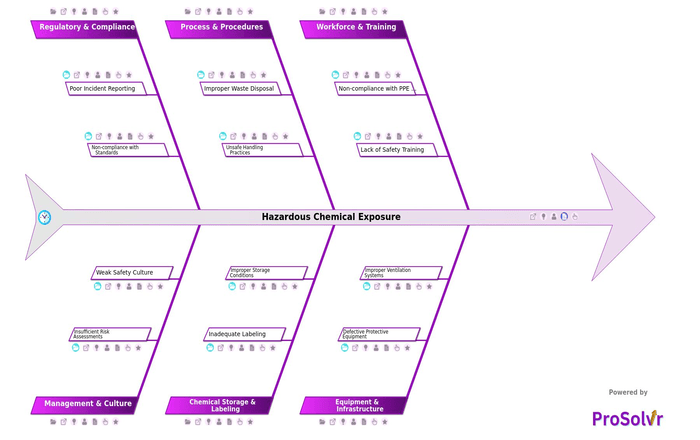
A Gen-AI powered root cause analysis using a fishbone diagram and Six Sigma principles helps organizations identify the real causes behind hazardous chemical exposure. Instead of stopping at surface-level fixes, RCA examines workforce training, PPE compliance, ventilation systems, chemical handling SOPs, storage and labeling, incident reporting, GMP compliance, risk assessments, and management commitment. ProSolvr supports this structured RCA approach by converting incident learnings into clear root causes, stronger CAPA recommendations, and preventive safety actions that reduce recurrence and strengthen the organization’s safety culture.

Hazardous Chemical Exposure

    • Workforce & Training
      • Non-compliance with PPE Use
        • Poor enforcement by supervisors
        • Discomfort with PPE
      • Lack of Safety Training
        • Limited refresher courses
        • Inadequate onboarding programs
    • Equipment & Infrastructure
      • Defective Protective Equipment
        • Poor PPE quality assurance
        • Expired or damaged respirators
      • Improper Ventilation Systems
        • Inadequate air filtration
        • Faulty exhaust systems
    • Process & Procedures
      • Improper Waste Disposal
        • Lack of spill containment measures
        • Mixing incompatible chemicals
      • Unsafe Handling Practices
        • Shortcuts due to time pressure
        • Inadequate SOPs for chemical handling
    • Chemical Storage & Labeling
      • Inadequate Labeling
        • Misleading chemical information
        • Missing hazard labels
      • Improper Storage Conditions
        • Incorrect temperature/humidity control
        • Overcrowded storage areas
    • Regulatory & Compliance
      • Poor Incident Reporting
        • Ineffective corrective actions
        • Underreporting of near-misses
      • Non-compliance with Standards
        • Delays in regulatory audits
        • Incomplete adherence to OSHA/GMP guidelines
    • Management & Culture
      • Insufficient Risk Assessments
        • Failure to update risk registers
        • Infrequent hazard analysis
      • Weak Safety Culture
        • Lack of leadership commitment
        • Productivity prioritized over safety

Suggested Actions Checklist

Here are some corrective actions, preventive actions and investigative actions that organizations may find useful:

    • Workforce & Training
      • Non-compliance with PPE Use
        • Corrective Actions:
          • Issue disciplinary measures for repeated non-compliance; reinforce PPE importance through toolbox talks.
        • Preventive Actions:
          • Introduce incentive programs for consistent PPE usage; integrate PPE compliance into performance reviews.
        • Investigative Actions:
          • Review PPE compliance records and interview employees to understand barriers to usage.
      • Lack of Safety Training
        • Corrective Actions:
          • Organize immediate training sessions for employees in high-risk areas.
        • Preventive Actions:
          • Develop a structured training calendar with mandatory participation and tracking.
        • Investigative Actions:
          • Audit training records to identify gaps and assess trainer effectiveness.
    • Equipment & Infrastructure
      • Defective Protective Equipment
        • Corrective Actions:
          • Replace defective PPE immediately and withdraw faulty batches from use.
        • Preventive Actions:
          • Implement rigorous incoming inspection and supplier audits for PPE quality assurance.
        • Investigative Actions:
          • Trace defective equipment to supplier batches and investigate procurement practices.
      • Improper Ventilation Systems
        • Corrective Actions:
          • Repair or replace malfunctioning ventilation units promptly.
        • Preventive Actions:
          • Establish preventive maintenance schedules and routine air quality monitoring.
        • Investigative Actions:
          • Conduct root cause analysis of failures—design flaws, maintenance gaps, or overload issues.
    • Process & Procedures
      • Improper Waste Disposal
        • Corrective Actions:
          • Contain and safely dispose of improperly discarded waste immediately.
        • Preventive Actions:
          • Standardize waste disposal SOPs and provide specialized disposal bins.
        • Investigative Actions:
          • Review disposal logs and interview staff to identify procedural lapses.
      • Unsafe Handling Practices
        • Corrective Actions:
          • Retrain workers involved in unsafe handling incidents.
        • Preventive Actions:
          • Simplify SOPs, reinforce safe handling practices through simulations and drills.
        • Investigative Actions:
          • Analyze time pressure factors and workflow bottlenecks contributing to shortcuts.
      • Chemical Storage & Labeling
        • Corrective Actions:
          • Relabel chemicals with accurate hazard warnings and reorganize storage.
        • Preventive Actions:
          • Introduce digital inventory management and routine storage inspections.
        • Investigative Actions:
          • Audit labeling practices and verify supplier-provided hazard communication.
    • Regulatory & Compliance
      • Poor Incident Reporting
        • Corrective Actions:
          • Reopen unresolved incidents and implement corrective measures.
        • Preventive Actions:
          • Introduce an anonymous digital reporting system to encourage transparency.
        • Investigative Actions:
          • Review past incident reports and assess why near-misses were underreported.
      • Non-compliance with Standards
        • Corrective Actions:
          • Conduct immediate compliance checks and rectify deviations.
        • Preventive Actions:
          • Schedule periodic third-party audits and maintain a regulatory compliance tracker.
        • Investigative Actions:
          • Analyze missed audit deadlines or incomplete adherence to guidelines.
    • Management & Culture
      • Insufficient Risk Assessments
        • Corrective Actions:
          • Perform immediate risk assessments in high-risk operations.
        • Preventive Actions:
          • Establish a structured schedule for periodic risk register updates and hazard analysis.
        • Investigative Actions:
          • Evaluate why risk assessments were outdated—lack of resources, training, or prioritization.
      • Weak Safety Culture
        • Corrective Actions:
          • Launch leadership-led safety campaigns to reinforce commitment.
        • Preventive Actions:
          • Integrate safety KPIs into organizational goals and recognition programs.
        • Investigative Actions:
          • Conduct employee surveys and interviews to uncover cultural gaps and resistance points.
 

Who can learn from the Hazardous Chemical Exposure template?

  • Health and Safety Teams: They can gain insights into training gaps, PPE compliance issues, and ventilation failures, helping them strengthen workplace safety standards.
  • Manufacturing and Operations Teams: By understanding risks from unsafe handling practices or improper waste disposal, they can improve day-to-day operational controls.
  • Regulatory and Compliance Officers: They can use RCA findings to ensure adherence to OSHA and GMP guidelines, while addressing gaps in reporting and audit readiness.
  • Training and HR Departments: The analysis highlights where onboarding and refresher programs fall short, guiding more effective safety education and workforce development.
  • Engineering and Maintenance Teams: They can learn about infrastructure-related issues such as faulty exhaust systems or defective protective equipment, enabling better maintenance planning.
  • Leadership and Management: RCA outcomes reveal how weak safety culture and insufficient risk assessments contribute to incidents, helping leaders drive stronger safety-first initiatives.

Why use this template?

RCA provides a powerful framework for transforming hazardous chemical exposure incidents into opportunities for systemic improvement. ProSolvr helps pharmaceutical teams map out interconnected causes of hazardous chemical exposure, prioritize the most critical contributors, and translate insights into actionable CAPA. Through Gen-AI enabled analysis and CAPA integration, pharmaceutical companies can build safer workplaces, reduce operational risks, and maintain compliance with industry standards.

Use ProSolvr by smartQED to effectively eliminate problems in your pharmaceutical plants.

Curated from community experience and public sources:

  • https://www.prevor.com/en/chemical-risks-in-pharmaceutical-industry//
  • https://www.journals.innovareacademics.in/index.php/ajpcr/article/download/23160/13891
