






ProSolvr logo

Resolve problems, permanently

High Rate of Defects Root Cause Analysis

High Rate of Defects Root Cause Analysis

A high defect rate refers to a situation where products or services consistently fail to meet defined quality standards. In the business environment, this is more than just a quality issue as it represents a strategic and financial risk. Defects lead to rework, scrap, warranty claims, customer complaints, and in severe cases, product recalls. Over time, a persistent high defect rate erodes customer trust, damages brand reputation, and increases operational costs. Internally, it creates a firefighting culture where teams focus on fixing symptoms instead of addressing the underlying causes, ultimately reducing productivity and profitability.

From a business perspective, high defect rates also disrupt planning and decision-making. Production schedules become unreliable, delivery timelines slip, and cost estimates lose accuracy. Incorrect process parameters or improper setup instructions can silently introduce defects that compound over time. When these issues are not systematically analyzed, organizations often apply temporary fixes that fail to prevent recurrence.

This is where AI-assisted root cause analysis (RCA) becomes valuable for post-incident problem solving. Techniques such as the Fishbone Diagram, when applied within the disciplined framework of Six Sigma, help teams structure their thinking and move logically from the problem statement to the true root causes. The Fishbone approach enables clear categorization of possible causes so that contributing factors are not overlooked. By applying Six Sigma principles, the analysis emphasizes cause-and-effect clarity, process discipline, and evidence-based reasoning rather than guesswork or blame.

A structured root cause analysis also directly supports the development of effective Corrective and Preventive Actions (CAPA). This ensures that CAPA initiatives are not superficial but grounded in a clear understanding of cause relationships. A root cause analysis platform such as ProSolvr supports this investigation by enabling teams to visually map causes, collaborate during analysis, and document findings systematically. This helps organizations improve the effectiveness of problem solving and reduce the recurrence of quality failures.

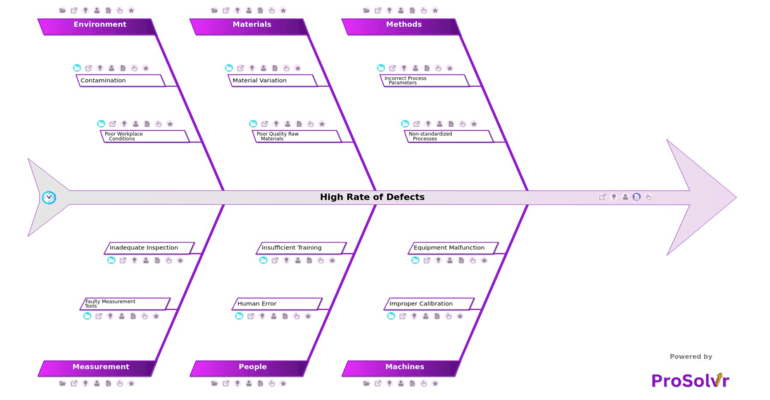
High Rate of Defects

    • Methods
      • Incorrect Process Parameters
        • Improper setup instructions
      • Non-standardized Processes
        • Lack of documented SOPs
    • Machines
      • Improper Calibration
        • Missed calibration schedule
      • Equipment Malfunction
        • Worn-out components
    • Materials
      • Material Variation
        • Inconsistent material batches
      • Poor Quality Raw Materials
        • Unqualified suppliers
    • People
      • Human Error
        • Fatigue due to overtime
      • Insufficient Training
        • Operators not certified
    • Environment
      • Contamination
        • Dirty work areas
      • Poor Workplace Conditions
        • Inadequate lighting
    • Measurement
      • Faulty Measurement Tools
        • Outdated inspection equipment
      • Inadequate Inspection
        • Sampling errors

Suggested Actions Checklist

Here are some corrective actions, preventive actions and investigative actions that organizations may find useful:

    • Methods
      • Incorrect Process Parameters
        • Corrective Actions:
          • Adjust process parameters to approved specifications and rework or scrap affected units.
        • Preventive Actions:
          • Implement parameter lock controls and periodic process audits to ensure adherence.
        • Investigative Actions:
          • Review recent process change records and deviations to identify how incorrect parameters were introduced.
      • Non-standardized Processes
        • Corrective Actions:
          • Standardize current processes and align all operations to a single approved method.
        • Preventive Actions:
          • Establish and enforce documented SOPs with mandatory compliance checks.
        • Investigative Actions:
          • Assess process variations across shifts or locations to identify inconsistencies.
    • Machines
      • Improper Calibration
        • Corrective Actions:
          • Calibrate affected machines immediately and verify product quality post-calibration.
        • Preventive Actions:
          • Introduce an automated calibration schedule with alerts and accountability.
        • Investigative Actions:
          • Review calibration records to determine missed or overdue activities.
      • Equipment Malfunction
        • Corrective Actions:
          • Repair or replace malfunctioning equipment to restore safe operation.
        • Preventive Actions:
          • Implement a preventive maintenance program targeting critical machine components.
        • Investigative Actions:
          • Analyze equipment failure history to identify recurring malfunction patterns.
    • Materials
      • Material Variation
        • Corrective Actions:
          • Segregate and stop usage of non-conforming material batches.
        • Preventive Actions:
          • Strengthen incoming material inspection and supplier quality requirements.
        • Investigative Actions:
          • Trace material batches to identify sources of variation.
      • Poor Quality Raw Materials
        • Corrective Actions:
          • Reject poor-quality raw materials and switch to approved alternatives.
        • Preventive Actions:
          • Qualify suppliers through audits and ongoing performance monitoring.
        • Investigative Actions:
          • Review supplier quality records and past non-conformance reports.
    • People
      • Human Error
        • Corrective Actions:
          • Retrain operators involved in the incident on correct procedures.
        • Preventive Actions:
          • Introduce workload management and fatigue monitoring practices.
        • Investigative Actions:
          • Evaluate work schedules and task assignments at the time of the incident.
      • Insufficient Training
        • Corrective Actions:
          • Remove uncertified operators from critical tasks until training is completed.
        • Preventive Actions:
          • Establish a certification-based authorization system for operators.
        • Investigative Actions:
          • Review training records to identify gaps in skill qualification.
    • Environment
      • Contamination
        • Corrective Actions:
          • Clean and sanitize affected work areas immediately.
        • Preventive Actions:
          • Implement regular housekeeping schedules and cleanliness audits.
        • Investigative Actions:
          • Identify contamination sources through area inspection and workflow review.
      • Poor Workplace Conditions
        • Corrective Actions:
          • Improve lighting and workplace conditions in affected areas.
        • Preventive Actions:
          • Conduct periodic workplace environment assessments.
        • Investigative Actions:
          • Review incident location conditions against safety and ergonomic standards.
    • Measurement
      • Faulty Measurement Tools
        • Corrective Actions:
          • Replace or repair faulty measurement tools and recheck affected products.
        • Preventive Actions:
          • Establish a tool verification and replacement program.
        • Investigative Actions:
          • Examine tool maintenance and calibration history.
      • Inadequate Inspection
        • Corrective Actions:
          • Perform additional inspections on recent production lots.
        • Preventive Actions:
          • Enhance inspection procedures and sampling plans.
        • Investigative Actions:
          • Review inspection methods and acceptance criteria used prior to the incident.
 

Who can learn from the High Rate of Defects template?

  • Production and Manufacturing Managers: They can identify weaknesses in methods, machines, materials, and workforce practices that directly impact defect rates.
  • Quality Assurance and Quality Control Teams: They can strengthen inspection, measurement, calibration, and defect prevention processes.
  • Process Engineers and Industrial Engineers: They can improve process parameters, standardization, and overall process capability.
  • Maintenance and Reliability Engineers: They can address equipment calibration issues, malfunctions, and preventive maintenance gaps.
  • Training and Human Resource Professionals: They can design targeted training programs, certification requirements, and fatigue management initiatives.
  • Senior Management and Operational Leaders: They can understand systemic issues across people, process, and environment, and support data-driven improvement initiatives.


Why use this template?

ProSolvr enables consistency in how root cause analysis (RCA) is conducted across incidents, supports collaborative investigation, and helps teams translate identified causes into effective Corrective and Preventive Actions (CAPA). As a result, organizations can move beyond reactive fixes and implement sustainable improvements that reduce recurring defects and strengthen overall business performance.

Use ProSolvr by smartQED to conduct structured root cause analysis, improve product quality, and reduce the recurrence of defects across your operations.

Curated from community experience and public sources:

  • https://kpidepot.com/kpi/quality-defects-rate
  • https://www.6sigma.us/six-sigma-in-focus/defects-per-unit-dpu/
