






ProSolvr logo

Resolve problems, permanently

Poor Business Risk Management Root Cause Analysis

Poor Business Risk Management Root Cause Analysis

Poor business risk management refers to an organization’s inability to systematically identify, assess, prioritize, and control risks that could impact its objectives. In the business environment, this weakness can lead to unexpected losses, operational disruptions, regulatory non-compliance, and reputational damage. When risks are not clearly owned or governed, decision-making becomes reactive rather than strategic. Over time, poor risk management weakens organizational resilience and limits a company’s ability to respond effectively to uncertainty and change.

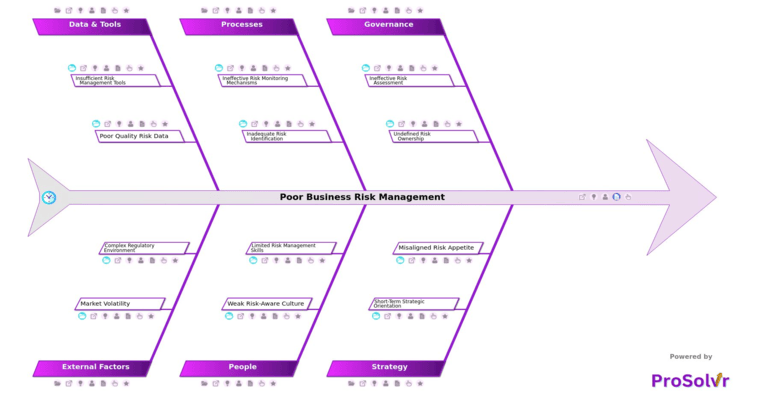
From a business perspective, poor risk management is often rooted in structural and strategic gaps. Ineffective risk assessment processes and the absence of a formal board-level risk committee weaken oversight and accountability. Similarly, undefined risk ownership creates ambiguity, allowing critical risks to go unmanaged. Misaligned risk appetite occurs when risk appetite and tolerance levels are not clearly articulated, resulting in decisions that expose the organization to unintended levels of risk.

A Generative AI–assisted root cause analysis using a Fishbone Diagram aligned with Six Sigma principles provides a structured way to address these issues after an incident has occurred. Instead of focusing only on symptoms such as financial loss or project failure, the Fishbone approach helps teams trace problems back to underlying causes across multiple dimensions.

The Six Sigma methodology reinforces clarity, consistency, and cause-and-effect reasoning, enabling teams to isolate the true drivers of failure. A root cause analysis application like ProSolvr supports this structured problem-solving process by guiding teams through systematic cause identification, visual analysis, and collaborative investigation.

Poor Business Risk Management

      • Governance
        • Ineffective Risk Assessment
          • Absence of a formal board-level risk committee
        • Undefined Risk Ownership
          • Roles and accountabilities for risk not formally assigned
      • Strategy
        • Short-Term Strategic Orientation
          • Emerging risks excluded from planning
        • Misaligned Risk Appetite
          • Risk appetite and tolerance levels not clearly articulated
      • Processes
        • Ineffective Risk Monitoring Mechanisms
          • Risk reviews conducted inconsistently
        • Inadequate Risk Identification
          • Lack of a standardized risk assessment framework
      • People
        • Weak Risk-Aware Culture
          • Leadership fails to consistently reinforce risk accountability
        • Limited Risk Management Skills
          • Insufficient role-based risk management training
      • Data & Tools
        • Insufficient Risk Management Tools
          • Reliance on manual and spreadsheet-based risk tracking
        • Poor Quality Risk Data
          • Risk information not regularly validated or updated
      • External Factors
        • Market Volatility
          • Exposure to rapid economic and industry fluctuations
        • Complex Regulatory Environment
          • Frequent regulatory changes without proactive impact assessment

Suggested Actions Checklist

Here are some corrective actions, preventive actions and investigative actions that organizations may find useful:

    • Governance
      • Ineffective Risk Assessment
        • Corrective Actions:
          • Conduct an enterprise-wide risk assessment to identify and document critical risks currently unassessed.
        • Preventive Actions:
          • Establish a formal, periodic risk assessment cycle integrated into governance and board review processes.
        • Investigative Actions:
          • Review past strategic and operational decisions to identify gaps where risks were not adequately assessed.
      • Undefined Risk Ownership
        • Corrective Actions:
          • Assign clear risk owners for all key enterprise risks and document responsibilities.
        • Preventive Actions:
          • Embed risk ownership roles into job descriptions and performance objectives.
        • Investigative Actions:
          • Analyze incidents and near-misses to determine where lack of ownership contributed to failures.
    • Strategy
      • Short-Term Strategic Orientation
        • Corrective Actions:
          • Update the strategic plan to explicitly include medium- and long-term risk considerations.
        • Preventive Actions:
          • Introduce scenario planning and forward-looking risk reviews as part of annual strategy formulation.
        • Investigative Actions:
          • Examine previous strategic initiatives to assess how exclusion of emerging risks affected outcomes.
      • Misaligned Risk Appetite
        • Corrective Actions:
          • Define and formally approve a clear risk appetite statement aligned with business objectives.
        • Preventive Actions:
          • Integrate risk appetite thresholds into decision-making and investment approval processes.
        • Investigative Actions:
          • Review key decisions to identify instances where risk-taking exceeded or conflicted with implicit tolerance levels.
    • Processes
      • Ineffective Risk Monitoring Mechanisms
        • Corrective Actions:
          • Implement a structured risk monitoring and reporting schedule across all functions.
        • Preventive Actions:
          • Standardize risk review frequencies and escalation triggers within core business processes.
        • Investigative Actions:
          • Assess missed or delayed risk escalations to determine breakdowns in monitoring processes.
      • Inadequate Risk Identification
        • Corrective Actions:
          • Conduct a comprehensive risk identification workshop across departments to capture overlooked risks.
        • Preventive Actions:
          • Adopt a standardized risk identification framework applicable across the organization.
        • Investigative Actions:
          • Review past incidents to identify risks that were not identified during initial assessments.
    • People
      • Weak Risk-Aware Culture
        • Corrective Actions:
          • Reinforce leadership accountability for risk management through formal communications and reviews.
        • Preventive Actions:
          • Embed risk awareness expectations into leadership evaluations and organizational values.
        • Investigative Actions:
          • Evaluate employee feedback and past risk events to assess cultural contributors to risk neglect.
      • Limited Risk Management Skills
        • Corrective Actions:
          • Provide targeted training to employees involved in risk-related decision-making.
        • Preventive Actions:
          • Implement ongoing, role-based risk management capability development programs.
        • Investigative Actions:
          • Assess skill gaps by reviewing errors or delays linked to inadequate risk knowledge.
    • Data & Tools
      • Insufficient Risk Management Tools
        • Corrective Actions:
          • Introduce a centralized risk management tool to replace manual tracking methods.
        • Preventive Actions:
          • Periodically review and upgrade risk tools to ensure they remain fit for purpose.
        • Investigative Actions:
          • Analyze inefficiencies and errors caused by existing tools to determine improvement needs.
      • Poor Quality Risk Data
        • Corrective Actions:
          • Validate and cleanse existing risk data to ensure accuracy and relevance.
        • Preventive Actions:
          • Define data quality standards and ownership for risk information maintenance.
        • Investigative Actions:
          • Trace decision failures back to inaccurate or outdated risk data sources.
    • External Factors
      • Market Volatility
        • Corrective Actions:
          • Reassess exposure levels and adjust controls for high-impact volatile risks.
        • Preventive Actions:
          • Incorporate volatility indicators and stress scenarios into routine risk reviews.
        • Investigative Actions:
          • Analyze past financial or operational impacts to understand sensitivity to market fluctuations.
      • Complex Regulatory Environment
        • Corrective Actions:
          • Conduct a regulatory gap assessment to identify non-compliances or delayed responses.
        • Preventive Actions:
          • Establish a structured regulatory monitoring and impact assessment process.
        • Investigative Actions:
          • Review regulatory breaches or penalties to identify failures in anticipating regulatory changes.
 

Who can learn from the Poor Business Risk Management template?

  • Board Members & Senior Leadership: They can gain insights into governance-related issues such as ineffective risk assessment and the absence of a formal board-level risk committee, helping strengthen oversight and accountability.
  • Enterprise Risk Management (ERM) & Risk Professionals: The RCA highlights gaps in risk identification, monitoring mechanisms, and risk ownership, enabling ERM teams to improve frameworks, methodologies, and CAPA implementation.
  • Business Unit Heads & Functional Managers: Understanding causes like short-term strategic orientation and misaligned risk appetite helps them align operational decisions with enterprise-level risk tolerance.
  • Compliance & Regulatory Affairs Teams: Lessons from complex regulatory environments and inadequate proactive impact assessment support stronger compliance planning and regulatory risk management.
  • Finance & Strategy Teams: They can learn how poor risk data quality, insufficient tools, and market volatility affect financial performance, forecasting, and strategic decision-making.
  • Human Resources & Learning Teams: Insights into weak risk-aware culture and limited risk management skills help HR design targeted training, leadership reinforcement, and capability-building initiatives.


Why use this template?

ProSolvr helps stakeholders collaboratively map the causes behind risk management failures in a clear and visual format. By combining structured analysis techniques such as the Fishbone Diagram with disciplined approaches like Six Sigma, the platform enables teams to systematically investigate incidents and identify the true drivers behind operational failures.

The application also supports CAPA thinking by helping organizations translate investigation outcomes into corrective and preventive actions. This allows teams to convert lessons learned from risk failures into sustainable improvements in governance, strategy, and operational risk management.

Use ProSolvr by smartQED to conduct structured root cause analysis, strengthen organizational learning, and reduce the recurrence of complex business problems.

Curated from community experience and public sources:

  • https://online.hbs.edu/blog/post/risk-management
  • https://hyperproof.io/resource/risk-management-techniques/
