






ProSolvr logo

Resolve problems, permanently

Root Cause Analysis for High Off-Gas Production

RCA of High Off-Gas Production

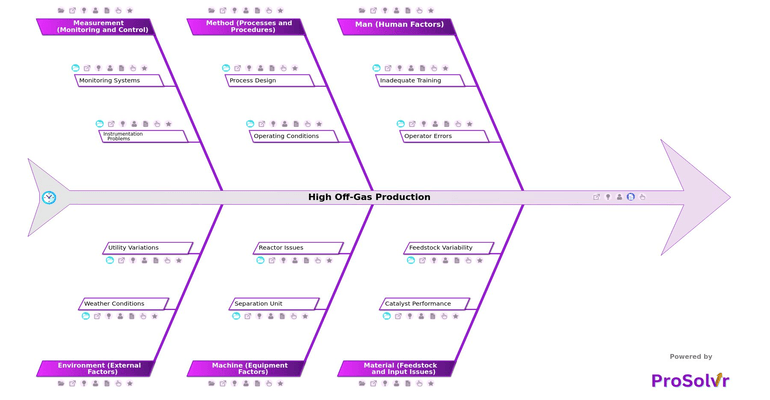
High off-gas production in petrochemical plants, caused by issues like inadequate separation, unstable reactions, and equipment inefficiencies, significantly impacts operational efficiency and profitability. Challenges stem from various factors, including Man (Human Factors) like inadequate training, poor troubleshooting skills, and operator errors, which result in incorrect operational settings and insufficient knowledge of feed-product balance. Material (Feedstock and Input Issues) such as feedstock variability, impurities, and catalyst deactivation further exacerbate off-gas levels. Additionally, Method (Processes and Procedures) play a role, with inefficient process flow designs, unstable reaction conditions, and deviations from ideal temperature or pressure compounding the problem.

ProSolvr, a GEN-AI-powered root cause analysis (RCA) application, provides petrochemical plants with a robust solution to these multifaceted challenges. By integrating a fishbone diagram (Ishikawa diagram) framework with Six Sigma principles, ProSolvr systematically categorizes potential causes across domains like Machine (Equipment Factors), addressing issues such as malfunctioning temperature controls, reactor fouling, and inefficient distillation columns. It also tackles Measurement (Monitoring and Control) gaps, including poor alarm systems, faulty gas flow meters, and inadequate real-time data analysis. ProSolvr’s advanced GEN-AI capabilities analyze interconnected factors, offering actionable insights to mitigate high off-gas production effectively.

What sets ProSolvr apart is its ability to address not just internal factors but also Environment (External Factors) like humidity and temperature extremes, as well as utility variations such as power supply instability. By identifying root causes and generating precise recommendations for corrective and preventive actions, ProSolvr empowers teams to reduce emissions, optimize processes, and achieve long-term operational excellence. With ProSolvr, petrochemical plants can transform high off-gas production challenges into opportunities for improved efficiency and sustainability.

High Off-Gas Production

    • Man (Human Factors)
      • Inadequate Training
        • Poor troubleshooting skills
      • Operator Errors
        • Insufficient knowledge of feed-product balance
        • Lack of understanding of system behavior
        • Incorrect operational settings
    • Material (Feedstock and Input Issues)
      • Catalyst Performance
        • Use of suboptimal catalyst
        • Deactivation of catalyst
      • Feedstock Variability
        • Impurities in raw materials
        • Low-quality feedstock with high volatile content
    • Method (Processes and Procedures)
      • Process Design
        • Inadequate separation stages
        • Inefficient process flow design
      • Operating Conditions
        • Unstable reaction conditions
        • Deviations from ideal temperature/pressure
    • Machine (Equipment Factors)
      • Separation Unit
        • Improper gas-liquid separation
        • Inefficient distillation column
      • Reactor Issues
        • Malfunctioning temperature controls
        • Reactor fouling
    • Measurement (Monitoring and Control)
      • Monitoring Systems
        • Poor alarm and notification systems
        • Inadequate real-time data analysis
      • Instrumentation Problems
        • Delayed response from sensors
        • Faulty gas flow meters
    • Environment (External Factors)
      • Weather Conditions
        • Humidity affecting equipment performance
        • Temperature extremes impacting operations
      • Utility Variations
        • Power supply instability
        • Fluctuations in steam or cooling water supply
 

Suggested Actions Checklist

Here are corrective, preventive, and investigative actions for Reactor Pressure Fluctuations which organizations may use.

    • Man (Human Factors)
      • Inadequate Training
        • Corrective Actions:
          • Conduct targeted refresher courses focusing on troubleshooting and feed-product balance principles.
        • Preventive Actions:
          • Implement a comprehensive onboarding program with periodic knowledge assessments and simulations.
        • Investigative Actions:
          • Review training records and compare with incident data to identify gaps in operator knowledge.
      • Operator Errors
        • Corrective Actions:
          • Implement standard operating procedures (SOPs) with detailed steps and error-proof instructions.
        • Preventive Actions:
          • Introduce competency-based certifications for operators to ensure mastery of system behavior and operational settings.
        • Investigative Actions:
          • Analyze historical operational data to identify patterns in operator errors and correlate with off-gas incidents.
    • Material (Feedstock and Input Issues)
      • Catalyst Performance
        • Corrective Actions:
          • Replace suboptimal or deactivated catalysts with higher-performance alternatives designed for the specific process.
        • Preventive Actions:
          • Establish a catalyst testing and monitoring schedule to evaluate performance before degradation affects output.
        • Investigative Actions:
          • Conduct a chemical analysis of used catalysts to identify degradation mechanisms or contamination.
      • Feedstock Variability
        • Corrective Actions:
          • Introduce feedstock pre-treatment systems to remove impurities and stabilize quality.
        • Preventive Actions:
          • Develop strict feedstock quality standards with supplier agreements ensuring consistent specifications.
        • Investigative Actions:
          • Analyze historical feedstock batches to trace quality deviations and link them to off-gas production spikes.
    • Method (Processes and Procedures)
      • Process Design
        • Corrective Actions:
          • Redesign separation stages and optimize the process flow to improve efficiency and minimize gas formation.
        • Preventive Actions:
          • Use advanced modeling tools during the design phase to simulate and prevent inefficiencies in process flow.
        • Investigative Actions:
          • Review past process design records and compare with industry benchmarks to identify weaknesses.
      • Operating Conditions
        • Corrective Actions:
          • Stabilize reaction conditions by adjusting temperature, pressure, or reactant flow rates to ideal parameters.
        • Preventive Actions:
          • Install advanced control systems to maintain precise operating conditions and automatically correct deviations.
        • Investigative Actions:
          • Analyze past operating logs to determine trends or events leading to unstable conditions.
    • Machine (Equipment Factors)
      • Separation Unit
        • Corrective Actions:
          • Clean and maintain separation units, replacing worn or inefficient components such as trays or packing.
        • Preventive Actions:
          • Conduct routine inspections and performance tests on gas-liquid separators and distillation columns.
        • Investigative Actions:
          • Evaluate maintenance records and identify correlations between performance dips and equipment age.
      • Reactor Issues
        • Corrective Actions:
          • Repair or replace malfunctioning temperature controls and remove fouling deposits from reactors.
        • Preventive Actions:
          • Implement a proactive maintenance schedule that includes regular reactor cleaning and control system checks.
        • Investigative Actions:
          • Perform root cause analysis on fouling deposits to identify process or material contributors.
    • Measurement (Monitoring and Control)
      • Monitoring Systems
        • Corrective Actions:
          • Upgrade or recalibrate alarm systems to improve sensitivity and reduce false positives/negatives.
        • Preventive Actions:
          • Implement a robust maintenance and calibration schedule for all monitoring equipment.
        • Investigative Actions:
          • Review alarm history and analyze missed or delayed notifications during high off-gas events.
      • Instrumentation Problems
        • Corrective Actions:
          • Replace faulty sensors and flow meters, and recalibrate instrumentation to improve response times.
        • Preventive Actions:
          • Invest in higher-quality sensors and meters with better accuracy and durability.
        • Investigative Actions:
          • Evaluate instrument failure rates and correlate with maintenance intervals or environmental factors.
    • Environment (External Factors)
      • Weather Conditions
        • Corrective Actions:
          • Install weather-resistant equipment enclosures and add dehumidifiers where humidity impacts performance.
        • Preventive Actions:
          • Design processes and equipment to operate efficiently under varying temperature and humidity conditions.
        • Investigative Actions:
          • Analyze historical production data during extreme weather to identify trends in equipment or process failures.
      • Utility Variations
        • Corrective Actions:
          • Stabilize power and utility supply through redundancy systems or auxiliary generators.
        • Preventive Actions:
          • Implement utility monitoring systems to detect fluctuations and switch to backup sources seamlessly.
        • Investigative Actions:
          • Review utility supply logs to identify patterns or frequency of fluctuations affecting operations.
 

Who can learn from the High Off-Gas Production template?

  • Operations Managers: Operations managers can use the template to analyze production inefficiencies, optimize processes, and improve overall plant performance by addressing off-gas issues systematically.
  • Process Engineers: Process engineers can identify technical flaws in reaction conditions or equipment performance, leveraging the template to design more stable and efficient processes.
  • Maintenance Teams: Maintenance teams can pinpoint recurring equipment failures, such as reactor fouling or faulty sensors, and plan proactive maintenance strategies using the template insights.
  • Training Coordinators: Training coordinators can use the template to identify skill gaps in operator knowledge and design targeted training programs to minimize human errors and improve troubleshooting capabilities.
  • Quality Assurance Teams: Quality assurance professionals can utilize the template to investigate material variability, catalyst issues, and deviations in quality standards that contribute to high off-gas production.
  • Environmental Compliance Officers: Environmental officers can focus on identifying and mitigating factors that lead to increased emissions, ensuring the plant meets regulatory requirements and reduces environmental impact.

Why use this template?

Using Six Sigma principles, a GEN-AI-driven root cause analysis with a quality and reliability tool like ProSolvr, focuses on reducing variability and enhancing process efficiency. Once the root causes are identified, suitable corrective and preventive actions (CAPA) can be implemented. The structured nature of a fishbone diagram ensures comprehensive exploration of potential causes, leaving no aspect of the operation unchecked. This not only enhances operational reliability but also aligns the plant’s performance with environmental and safety standards, ensuring sustainable operations.

By focusing on the root causes rather than surface-level symptoms, GEN-AI-powered RCA fosters long-term solutions, minimizing recurrence. Unlock effective root cause analysis with ProSolvr by smartQED to drive sustainable solutions and prevent future disruptions in your petrochemical plant.

Curated from community experience and public sources:

  • https://www.topsoe.com/processes/off-gas-processing
  • https://www.digitalrefining.com/article/1002727/refinery-off-gas-in-hydrogen-production
