







RCA of High Noise Levels
High noise levels are a common problem in petrochemical plants. They come from many sources like machinery vibrations, high-pressure operations, or inadequate acoustic design. These noise levels can create a dangerous workplace, causing hearing loss, making communication harder, and reducing worker safety. High noise levels can also be a sign of mechanical problems like corrosion, improper specifications, or lubrication problems. These issues don’t just make noise worse—they also harm equipment and lower efficiency, making it very important to control noise.
In petrochemical plants, aging equipment without a replacement plan or worn-out parts due to poor maintenance makes noise worse. Environmental factors like material expansion causing vibration or a poor plant layout with no sound barriers add to the problem. Problems like inefficient load balancing during operations or improper shutdown/startup procedures also increase noise levels, which puts stress on workers and machines. Solving these problems means finding the main causes and taking steps like Corrective and Preventive Actions (CAPA) to stop them from happening again.
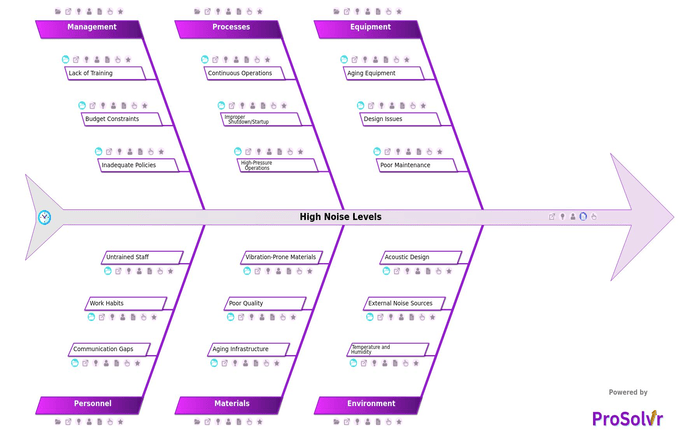
ProSolvr, a GEN-AI-powered root cause analysis application, helps petrochemical plants solve these noise issues. It uses a visual fishbone diagram and Six Sigma methods to group and organize the causes of noise. This makes it easier for teams to see the problem clearly and find solutions. ProSolvr helps plants fix mechanical issues, improve maintenance, and create safer, quieter workplaces.
High Noise Levels
- Equipment
- Aging Equipment
- Lack of replacement strategy
- Design Issues
- Outdated designs
- Poor Maintenance
- Worn-out components
- Environment
- Temperature and Humidity
- Material expansion causing vibration
- External Noise Sources
- Traffic or nearby industrial activity
- Acoustic Design
- Poor plant layout
- Processes
- Continuous Operations
- Inefficient load balancing
- Improper Shutdown/Startup
- Lack of optimized procedures
- High-Pressure Operations
- Improper pressure control
- Materials
- Aging Infrastructure
- Structural integrity issues
- Poor Quality
- Improper installation methods
- Vibration-Prone Materials
- Use of incompatible materials
- Management
- Lack of Training
- Lack of adherence to noise regulations
- Budget Constraints
- Low investment in noise control
- Inadequate Policies
- Weak noise abatement strategies
- Personnel
- Communication Gaps
- Ineffective feedback mechanisms
- Work Habits
- Overlooking maintenance schedules
- Untrained Staff
- Neglect of early warning signs
Suggested Actions Checklist
Here are some corrective actions, preventive actions and investigative actions which organizations may implement to tackle high noise levels in their plants.
- Equipment
- Aging Equipment
- Lack of replacement strategy
- Corrective Actions:
- Replace outdated equipment immediately if deemed unserviceable or causing excessive noise.
- Preventive Actions:
- Develop a lifecycle management plan to schedule regular replacements based on usage and wear data.
- Investigative Actions:
- Audit equipment age and performance to identify critical assets lacking a replacement plan.
- Corrosion or fatigue
- Corrective Actions:
- Conduct repairs or replace corroded/fatigued parts to restore integrity.
- Preventive Actions:
- Apply protective coatings and schedule periodic inspections for early detection of wear.
- Investigative Actions:
- Perform metallurgical analysis to determine the extent and root causes of degradation.
- Lack of replacement strategy
- Design Issues
- Outdated designs
- Corrective Actions:
- Retrofit machinery with modern, noise-reducing technologies.
- Preventive Actions:
- Ensure new acquisitions align with updated noise reduction standards.
- Investigative Actions:
- Review original design specifications and assess their limitations.
- Improper specifications
- Corrective Actions:
- Modify or upgrade components to meet operational needs.
- Preventive Actions:
- Improve design review processes to align specifications with operational requirements.
- Investigative Actions:
- Compare operational conditions against original design assumptions.
- Outdated designs
- Poor Maintenance
- Worn-out components
- Corrective Actions:
- Replace or repair damaged components causing excessive noise.
- Preventive Actions:
- Implement predictive maintenance programs using vibration analysis.
- Investigative Actions:
- Inspect maintenance logs to identify trends of recurrent failures.
- Lubrication issues
- Corrective Actions:
- Reapply appropriate lubricants and replace damaged parts if needed.
- Preventive Actions:
- Establish a lubrication management plan and use condition monitoring to avoid lapses.
- Investigative Actions:
- Investigate lubrication schedules and compliance with manufacturer guidelines.
- Worn-out components
- Aging Equipment
- Environment
- Temperature and Humidity
- Material expansion causing
vibration
- Corrective Actions:
- Adjust clearances or install dampers to reduce vibration impacts.
- Preventive Actions:
- Use materials with lower thermal expansion coefficients in critical components.
- Investigative Actions:
- Monitor environmental conditions and evaluate their impact on material performance.
- Effects on machinery noise
- Corrective Actions:
- Install noise-insulating enclosures for sensitive equipment.
- Preventive Actions:
- Optimize HVAC systems to stabilize temperature and humidity levels.
- Investigative Actions:
- Analyze noise patterns against environmental data to identify correlations.
- Material expansion causing
vibration
- External Noise Sources
- Traffic or nearby industrial
activity
- Corrective Actions:
- Install soundproof walls or acoustic barriers around the facility.
- Preventive Actions:
- Conduct site selection and soundproofing measures during plant construction or expansion.
- Investigative Actions:
- Perform environmental noise impact assessments to quantify external contributions.
- Traffic or nearby industrial
activity
- Acoustic Design
- Poor plant layout
- Corrective Actions:
- Rearrange equipment locations to minimize noise propagation.
- Preventive Actions:
- Incorporate acoustic modeling during future layout planning.
- Investigative Actions:
- Review existing layouts for noise hotspots and identify improvements.
- Lack of sound barriers
- Corrective Actions:
- Erect noise barriers or install acoustic insulation panels.
- Preventive Actions:
- Integrate noise control solutions during project design phases.
- Investigative Actions:
- Evaluate the efficacy of installed barriers through sound level measurements.
- Poor plant layout
- Temperature and Humidity
- Processes
- Continuous Operations
- Inefficient load balancing
- Corrective Actions:
- Redistribute loads to balance wear and noise generation.
- Preventive Actions:
- Automate load management with real-time monitoring systems.
- Investigative Actions:
- Analyze operational logs to identify imbalances and overload patterns.
- Unmonitored wear and tear
- Corrective Actions:
- Inspect and replace worn components.
- Preventive Actions:
- Implement a monitoring system to track wear rates and noise levels.
- Investigative Actions:
- Assess past maintenance records to determine unmonitored wear causes.
- Inefficient load balancing
- Improper Shutdown/Startup
- Lack of optimized procedures
- Corrective Actions:
- Develop and enforce standard operating procedures (SOPs) for shutdowns/startups.
- Preventive Actions:
- Train operators on optimized procedures to minimize noise-related risks.
- Investigative Actions:
- Review past incidents to evaluate procedural gaps.
- Sudden changes causing
vibration
- Corrective Actions:
- Gradually adjust operating parameters to prevent sudden vibrations.
- Preventive Actions:
- Use control systems with gradual ramp-up/down functionalities.
- Investigative Actions:
- Investigate the frequency and triggers of sudden parameter changes.
- Lack of optimized procedures
- High-Pressure Operations
- Improper pressure control
- Corrective Actions:
- Repair or recalibrate faulty pressure control systems.
- Preventive Actions:
- Install automated pressure monitoring and control mechanisms.
- Investigative Actions:
- Audit the performance of existing pressure regulation devices.
- Excessive flow velocities
- Corrective Actions:
- Replace undersized piping or valves causing excessive flow.
- Preventive Actions:
- Redesign flow systems to reduce velocities and noise.
- Investigative Actions:
- Analyze flow data for patterns contributing to elevated noise.
- Improper pressure control
- Continuous Operations
- Materials
- Aging Infrastructure
- Structural integrity issues
- Corrective Actions:
- Reinforce or replace structurally compromised sections.
- Preventive Actions:
- Schedule structural audits to detect early signs of deterioration.
- Investigative Actions:
- Conduct failure analysis on damaged components to understand root causes.
- Pipe thinning
- Corrective Actions:
- Replace affected sections to prevent leaks and noise amplification.
- Preventive Actions:
- Use ultrasonic testing to monitor wall thickness.
- Investigative Actions:
- Investigate process conditions causing accelerated thinning.
- Structural integrity issues
- Poor Quality
- Improper installation methods
- Corrective Actions:
- Reinstall components following correct procedures.
- Preventive Actions:
- Establish quality assurance checks during installations.
- Investigative Actions:
- Audit installation processes for adherence to standards.
- Substandard raw materials
- Corrective Actions:
- Replace faulty materials with certified alternatives.
- Preventive Actions:
- Strengthen procurement policies to source high-quality materials.
- Investigative Actions:
- Analyze supplier records to identify inconsistencies in material quality.
- Improper installation methods
- Vibration-Prone Materials
- Use of incompatible materials
- Corrective Actions:
- Substitute with vibration-resistant materials.
- Preventive Actions:
- Use simulation tools to select materials with suitable properties.
- Investigative Actions:
- Test and analyze material properties to ensure compatibility.
- Low-damping materials
- Corrective Actions:
- Add dampers or replace materials with high-damping alternatives.
- Preventive Actions:
- Incorporate vibration damping as a design requirement.
- Investigative Actions:
- Study the impact of material choices on noise levels.
- Use of incompatible materials
- Aging Infrastructure
- Management
- Lack of Training
- Lack of adherence to noise
regulations
- Corrective Actions:
- Conduct mandatory training on compliance with noise standards.
- Preventive Actions:
- Establish periodic refresher training sessions for all staff.
- Investigative Actions:
- Evaluate training program effectiveness through compliance audits.
- Insufficient awareness of noise
risks
- Corrective Actions:
- Organize awareness campaigns highlighting noise hazards.
- Preventive Actions:
- Incorporate noise risk education into onboarding programs.
- Investigative Actions:
- Assess employee knowledge levels through surveys or interviews.
- Lack of adherence to noise
regulations
- Budget Constraints
- Low investment in noise control
- Corrective Actions:
- Allocate emergency funds to address critical noise issues.
- Preventive Actions:
- Include dedicated noise control budgets in annual financial planning.
- Investigative Actions:
- Review past budgets to identify underinvestment trends.
- Deferred maintenance
- Corrective Actions:
- Address overdue maintenance tasks promptly.
- Preventive Actions:
- Implement a preventive maintenance program with prioritized funding.
- Investigative Actions:
- Examine the financial impact of maintenance delays.
- Low investment in noise control
- Inadequate Policies
- Weak noise abatement strategies
- Corrective Actions:
- Develop and implement robust noise abatement plans.
- Preventive Actions:
- Regularly review and update noise management policies.
- Investigative Actions:
- Compare current policies against industry best practices.
- Lack of regular inspections
- Corrective Actions:
- Schedule and perform immediate inspections for high-risk areas.
- Preventive Actions:
- Set up a periodic inspection program with defined responsibilities.
- Investigative Actions:
- Analyze past inspection records for frequency and scope gaps.
- Weak noise abatement strategies
- Lack of Training
- Personnel
- Communication Gaps
- Ineffective feedback mechanisms
- Corrective Actions:
- Implement clear reporting channels and ensure timely action on complaints.
- Preventive Actions:
- Develop structured feedback and escalation procedures.
- Investigative Actions:
- Investigate delays or breakdowns in communication chains.
- Delays in reporting issues
- Corrective Actions:
- Expedite issue resolution through direct reporting systems.
- Preventive Actions:
- Encourage a culture of proactive reporting and accountability.
- Investigative Actions:
- Assess trends in delayed reports to identify underlying causes.
- Ineffective feedback mechanisms
- Work Habits
- Overlooking maintenance
schedules
- Corrective Actions:
- Enforce adherence to scheduled maintenance through strict monitoring.
- Preventive Actions:
- Automate reminders and approvals for maintenance activities.
- Investigative Actions:
- Review compliance records for missed or overdue tasks.
- Improper installation
techniques
- Corrective Actions:
- Retrain staff responsible for installations.
- Preventive Actions:
- Certify workers on approved installation standards.
- Investigative Actions:
- Evaluate installation logs for patterns of repeated errors.
- Overlooking maintenance
schedules
- Untrained Staff
- Neglect of early warning signs
- Corrective Actions:
- Address overlooked issues and conduct refresher training on noise indicators.
- Preventive Actions:
- Use mentoring programs to improve on-the-job learning for early detection.
- Investigative Actions:
- Analyze incidents to evaluate training gaps in identifying noise-related risks.
- Inappropriate handling of
equipment
- Corrective Actions:
- Provide hands-on training for proper equipment operation.
- Preventive Actions:
- Require skill certification before granting operational responsibilities.
- Investigative Actions:
- Audit operational errors linked to inadequate handling practices.
- Neglect of early warning signs
- Communication Gaps
Who can learn from the High Noise Levels template?
- Maintenance Teams: Maintenance personnel can learn about the importance of regular inspections, timely lubrication, and predictive maintenance practices to prevent issues such as worn-out components and lubrication failures that contribute to high noise levels.
- Engineering and Design Teams: Engineers can use RCA findings to understand how outdated designs, improper specifications, and vibration-prone materials contribute to excessive noise, enabling them to incorporate noise-reduction principles into future equipment and facility designs.
- Management and Leadership: Managers can recognize the importance of adequate budget allocation, routine inspections, and robust policies to mitigate high noise risks. The RCA also highlights the value of investing in noise control measures and employee training.
- Operations Teams: Operators can gain insights into how improper shutdown and startup procedures, inefficient load balancing, and high-pressure operations contribute to excessive noise, helping them optimize operational practices and reduce equipment stress.
- Health, Safety, and Environment (HSE) Professionals: HSE teams can use the RCA to understand how environmental factors, such as poor acoustic design and external noise sources, affect plant noise levels, enabling them to implement effective noise abatement strategies and protect worker health.
- Training and Development Teams: Training personnel can leverage the RCA to develop targeted programs that address gaps in staff knowledge and skills, including early warning sign recognition, proper equipment handling, and adherence to noise control regulations.
Why use this template?
By addressing the root causes, organizations can not only resolve current issues but also establish robust preventive strategies to minimize future noise-related risks in petrochemical plants. This systematic process reinforces operational reliability and worker safety, ensuring compliance with regulatory standards and fostering a proactive organizational culture. This approach also facilitates the development of CAPA measures and helps organizations get rid of challenges permanently over time.
Struggling with persistent noise challenges in your plant? ProSolvr by smartQED, can simplify root cause analysis (RCA) with its user-friendly platform, integrating Six Sigma principles to identify, analyze, and resolve issues effectively


