






ProSolvr logo

Resolve problems, permanently

Root Cause Analysis of Faulty Diagnostic Services

RCA of Faulty Diagnostic Services

Faulty diagnostic services in hospitals refer to errors, delays, or inconsistencies in identifying a patient’s medical condition through laboratory testing, medical imaging, clinical evaluation, or specialist interpretation. These failures may occur due to human error, inadequate procedures, poor-quality equipment, insufficient training, fragmented workflows, or communication gaps between healthcare professionals.

Diagnostic accuracy is the foundation of effective treatment. Even seemingly minor lapses, such as incorrect laboratory results, misinterpreted scans, delayed reports, or incomplete clinical information, can significantly affect patient outcomes. This is a critical concern in healthcare because diagnostic failures directly impact patient safety, treatment effectiveness, operational efficiency, and trust in the healthcare system. An incorrect or delayed diagnosis can lead to inappropriate treatment, disease progression, unnecessary procedures, increased healthcare costs, extended hospital stays, and, in severe cases, irreversible harm or loss of life.

For hospitals, faulty diagnostic services can also result in legal liability, reputational damage, repeat testing, resource wastage, and increased pressure on already constrained clinical and administrative teams.

Root Cause Analysis provides a structured way to address these failures by looking beyond immediate mistakes and identifying the underlying systemic causes. Instead of focusing only on individual errors, RCA examines broader contributing factors such as process gaps, inadequate training, equipment malfunction, poor documentation, communication breakdowns, workload pressure, and organizational weaknesses.

By mapping cause-and-effect relationships, healthcare organizations can define targeted corrective, preventive, and investigative actions that reduce recurrence and improve diagnostic reliability. AI-powered visual RCA platforms such as ProSolvr can further strengthen this process by organizing complex incident data, identifying recurring patterns across diagnostic failures, and helping teams build clear cause-and-effect structures. This supports faster investigations, better collaboration, stronger accountability, and more effective problem resolution across healthcare operations.

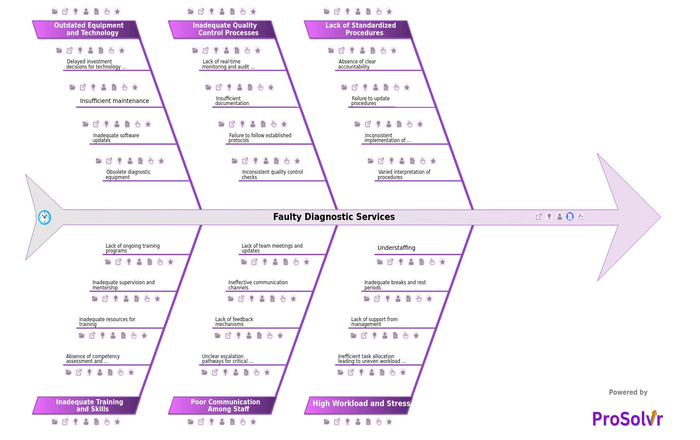
Faulty Diagnostic Services

    • Lack of Standardized Procedures
      • Failure to update procedures
      • Inconsistent implementation of protocols
      • Varied interpretation of procedures
      • Absence of clear accountability for procedure ownership
    • High Workload and Stress
      • Lack of support from management
      • Inadequate breaks and rest periods
      • Understaffing
      • Inefficient task allocation leading to uneven workload distribution
    • Inadequate Quality Control Processes
      • Insufficient documentation
      • Failure to follow established protocols
      • Inconsistent quality control checks
      • Lack of real-time monitoring and audit mechanisms
    • Poor Communication Among Staff
      • Lack of feedback mechanisms
      • Ineffective communication channels
      • Lack of team meetings and updates
      • Unclear escalation pathways for critical diagnostic issues
    • Outdated Equipment and Technology
      • Insufficient maintenance
      • Inadequate software updates
      • Obsolete diagnostic equipment
      • Delayed investment decisions for technology upgrades
    • Inadequate Training and Skills
      • Inadequate resources for training
      • Inadequate supervision and mentorship
      • Lack of ongoing training programs
      • Absence of competency assessment and certification systems

Suggested Actions Checklist

Here are some corrective actions, preventive actions and investigative actions that organizations may find useful:

    • Lack of Standardized Procedures
      • Corrective Actions:
        • Develop and implement standardized diagnostic procedures across all departments with immediate effect.
      • Preventive Actions:
        • Establish a periodic review and update mechanism to ensure procedures remain current and uniformly applied.
      • Investigative Actions:
        • Audit existing procedures and identify gaps, inconsistencies, and areas lacking ownership or accountability.
    • High Workload and Stress
      • Corrective Actions:
        • Redistribute workload and recruit temporary or permanent staff to address immediate staffing shortages.
      • Preventive Actions:
        • Implement workforce planning and scheduling systems to ensure balanced task allocation and adequate rest periods.
      • Investigative Actions:
        • Analyze staffing patterns, workload distribution, and employee feedback to identify root causes of stress and inefficiency.
    • Inadequate Quality Control Processes
      • Corrective Actions:
        • Reinforce adherence to quality control protocols and standardize documentation practices immediately.
      • Preventive Actions:
        • Introduce regular quality audits and establish consistent quality control checkpoints across processes.
      • Investigative Actions:
        • Review past quality incidents and audit reports to identify recurring lapses in quality control implementation.
    • Poor Communication Among Staff
      • Corrective Actions:
        • Implement structured communication channels and conduct regular team briefings to address immediate gaps.
      • Preventive Actions:
        • Establish formal communication protocols, including escalation pathways and feedback mechanisms.
      • Investigative Actions:
        • Assess communication breakdowns through staff interviews and incident reviews to identify systemic issues.
    • Outdated Equipment and Technology
      • Corrective Actions:
        • Repair or replace obsolete equipment and ensure all systems are updated and fully functional.
      • Preventive Actions:
        • Create a technology upgrade and maintenance schedule with allocated budgets and timelines.
      • Investigative Actions:
        • Evaluate equipment performance logs and maintenance records to identify patterns of failure or delays in upgrades.
    • Inadequate Training and Skills
      • Corrective Actions:
        • Conduct immediate training sessions to address critical skill gaps among staff.
      • Preventive Actions:
        • Implement continuous training programs along with competency assessments and certification systems.
      • Investigative Actions:
        • Analyze training records and performance data to identify deficiencies in skill development and supervision.
 

Who can learn from the Faulty Diagnostic Services template?

  • Healthcare Administrators and Hospital Management: They can identify systemic gaps in processes, resource allocation, and policy enforcement, enabling them to strengthen governance, invest in better infrastructure, and ensure accountability across diagnostic services.
  • Doctors and Clinicians: They can better understand how diagnostic errors occur and improve their clinical decision-making, interpretation of test results, and coordination with diagnostic teams to enhance patient outcomes.
  • Laboratory Technicians and Radiology Staff: As primary handlers of diagnostic procedures, they can improve adherence to protocols, ensure accuracy in testing and reporting, and recognize the importance of quality control measures.
  • Nursing Staff: They play a critical role in sample collection, patient preparation, and communication of diagnostic information. RCA insights help them minimize pre-analytical errors and improve coordination with labs and physicians.
  • Quality Assurance and Compliance Teams: They can use RCA findings to strengthen audit systems, standardize procedures, and implement robust quality control frameworks to reduce variability and errors in diagnostics.
  • Training and Development Teams: They can design targeted training programs based on identified skill gaps, ensuring continuous learning, competency development, and effective use of diagnostic technologies.

Why use this template?

By reducing the time and effort required for analysis and improving the depth of insights, GenAI-driven applications like ProSolvr enable healthcare organizations to make faster, more informed decisions. ProSolvr can assist healthcare professionals to generate actionable CAPA plans, ensuring that solutions are not only reactive but also preventive. This ultimately leads to improved diagnostic accuracy, better patient outcomes, and a more resilient healthcare system.

Use ProSolvr by smartQED to successfully eliminate issues that can lead to faulty diagnosis to ensure better healthcare facilities for patients.

Curated from community experience and public sources:

  • https://www.longdom.org/open-access/maintenance-practice-causes-of-failure-and-risk-assessment-of-diagnostic-medical-equipment-24518.html
  • https://clpmag.com/resource-center/research/new-data-reveals-leading-causes-of-diagnostic-errors-in-u-s-healthcare/
