






ProSolvr logo

Resolve problems, permanently

Excessive VOC Emissions Root Cause Analysis

RCA of Excessive VOC Emissions

Volatile Organic Compounds (VOCs) are organic chemicals that easily vaporize into the atmosphere, posing significant health and environmental risks. Excessive VOC emissions in petrochemical plants occur when these emissions exceed permissible limits, often due to failures in systems, equipment, or processes designed to control them. Such emissions can damage a company’s reputation, result in costly fines, and lead to production interruptions from shutdowns required for corrective actions.

In petrochemical settings, these emissions contribute to environmental pollution and regulatory violations, and can also pose workplace hazards, such as toxic exposure and an increased risk of fires or explosions.

For example, inadequate ventilation systems—such as those with poor design or maintenance—can allow VOCs to accumulate in work areas, increasing health risks to personnel. Improper chemical storage, including failure to segregate incompatible chemicals, may lead to dangerous chemical reactions that release VOCs. Inefficient monitoring systems, such as outdated or uncalibrated technology, can result in undetected emissions, exacerbating the issue. Equipment malfunctions from irregular maintenance or worn-out parts, as well as insufficient training in emission control, further contribute to uncontrolled VOC emissions.

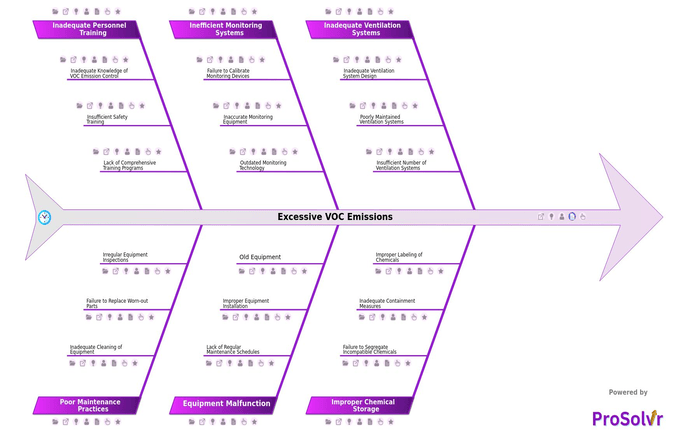
ProSolvr, a GEN-AI-powered root cause analysis application, revolutionizes how petrochemical plants manage VOC emissions. By using a structured fishbone diagram framework and Six Sigma principles, ProSolvr systematically identifies root causes, categorizes them into actionable areas, and provides tailored Corrective and Preventive Actions (CAPA). By addressing inefficiencies in monitoring, storage, ventilation, and training, ProSolvr helps organizations achieve regulatory compliance, improve workplace safety, and ensure sustainable operations.

Excessive VOC Emissions

    • Inadequate Ventilation Systems
      • Inadequate Ventilation System Design
      • Poorly Maintained Ventilation Systems
      • Insufficient Number of Ventilation Systems
    • Improper Chemical Storage
      • Failure to Segregate Incompatible Chemicals
      • Inadequate Containment Measures
      • Improper Labeling of Chemicals
    • Inefficient Monitoring Systems
      • Failure to Calibrate Monitoring Devices
      • Inaccurate Monitoring Equipment
      • Outdated Monitoring Technology
    • Equipment Malfunction
      • Lack of Regular Maintenance Schedules
      • Improper Equipment Installation
      • Old Equipment
    • Inadequate Personnel Training
      • Inadequate Knowledge of VOC Emission Control
      • Insufficient Safety Training
      • Lack of Comprehensive Training Programs
    • Poor Maintenance Practices
      • Inadequate Cleaning of Equipment
      • Failure to Replace Worn-out Parts
      • Irregular Equipment Inspections
 

Suggested Actions Checklist

These corrective, preventive and investigative actions can provide a structured approach to addressing excessive VOC emissions and mitigating their recurrence.

    • Inadequate Ventilation Systems
      • Inadequate Ventilation System Design
        • Corrective Actions:
          • Redesign ventilation systems to ensure adequate airflow capacity and compliance with industry standards.
        • Preventive Actions:
          • Implement a design review process for future installations to include adequate ventilation considerations.
        • Investigative Actions:
          • Review design specifications and historical performance data to identify where airflow requirements were underestimated.
      • Poorly Maintained Ventilation Systems
        • Corrective Actions:
          • Perform immediate inspection and servicing of ventilation systems, including cleaning and replacing damaged components.
        • Preventive Actions:
          • Establish a regular maintenance schedule for ventilation systems and assign accountability for ongoing monitoring.
        • Investigative Actions:
          • Inspect maintenance logs and records to identify gaps in maintenance schedules and actions.
      • Insufficient Number of Ventilation Systems
        • Corrective Actions:
          • Install additional ventilation units in areas identified as high-risk for VOC buildup.
        • Preventive Actions:
          • Conduct a risk assessment to determine future ventilation needs during plant expansions or modifications.
        • Investigative Actions:
          • Review plant layout and identify areas where additional systems could be required to meet safety standards.
    • Improper Chemical Storage
      • Failure to Segregate Incompatible Chemicals
        • Corrective Actions:
          • Reorganize the storage layout and segregate incompatible chemicals immediately.
        • Preventive Actions:
          • Develop and enforce strict chemical segregation protocols as part of a site-wide chemical safety program.
        • Investigative Actions:
          • Conduct a safety audit of chemical storage practices and identify if incompatible chemicals were stored together previously.
      • Inadequate Containment Measures
        • Corrective Actions:
          • Install or repair containment measures such as secondary containment or spill barriers.
        • Preventive Actions:
          • Designate a team for periodic containment system inspections and enhancements.
        • Investigative Actions:
          • Investigate the failure of containment measures by examining design plans and past maintenance work on containment systems.
      • Improper Labeling of Chemicals
        • Corrective Actions:
          • Label all chemicals correctly and ensure they are easily identifiable.
        • Preventive Actions:
          • Establish a standard operating procedure (SOP) for chemical labeling and periodic audits of labeling practices.
        • Investigative Actions:
          • Check inventory records and spot-check chemical containers to assess labeling compliance.
    • Inefficient Monitoring Systems
      • Failure to Calibrate Monitoring Devices
        • Corrective Actions:
          • Immediately calibrate all affected monitoring devices and verify readings.
        • Preventive Actions:
          • Create and enforce a calibration schedule for all monitoring devices, ensuring that they are checked regularly.
        • Investigative Actions:
          • Investigate calibration records to identify missed or incomplete calibrations.
      • Inaccurate Monitoring Equipment
        • Corrective Actions:
          • Replace or repair inaccurate monitoring equipment.
        • Preventive Actions:
          • Introduce a regular review and validation process for monitoring equipment performance.
        • Investigative Actions:
          • Test equipment accuracy against industry standards or cross-check with alternative measurement tools to identify discrepancies.
      • Outdated Monitoring Technology
        • Corrective Actions:
          • Upgrade to modern, more accurate monitoring equipment.
        • Preventive Actions:
          • Establish a technology review cycle to replace outdated monitoring systems every 3-5 years.
        • Investigative Actions:
          • Review the age and functionality of all monitoring systems and assess their effectiveness against current technological standards.
    • Equipment Malfunction
      • Lack of Regular Maintenance Schedules
        • Corrective Actions:
          • Create and implement a detailed maintenance schedule for all critical equipment.
        • Preventive Actions:
          • Assign dedicated personnel to monitor and enforce the adherence to maintenance schedules.
        • Investigative Actions:
          • Audit previous maintenance logs and identify any recurring patterns of neglect or scheduling gaps.
      • Improper Equipment Installation
        • Corrective Actions:
          • Correct installation errors and ensure proper setup of all equipment.
        • Preventive Actions:
          • Introduce a detailed installation checklist and post-installation review to ensure compliance with design specifications.
        • Investigative Actions:
          • Conduct an audit of installation practices and review past installation records for inconsistencies or errors.
      • Old Equipment
        • Corrective Actions:
          • Replace aging equipment that no longer meets safety or operational standards.
        • Preventive Actions:
          • Implement an asset lifecycle management program to replace equipment based on age and performance benchmarks.
        • Investigative Actions:
          • Review equipment maintenance and failure history to determine which items are most likely to fail due to age.
    • Inadequate Personnel Training
      • Inadequate Knowledge of VOC Emission Control
        • Corrective Actions:
          • Conduct immediate refresher training on VOC emission control for relevant personnel.
        • Preventive Actions:
          • Develop a comprehensive training program that includes regular updates and certifications on VOC management.
        • Investigative Actions:
          • Review training records and conduct skill assessments to identify knowledge gaps.
      • Insufficient Safety Training
        • Corrective Actions:
          • Provide emergency response and safety training to employees, focusing on VOC-related hazards.
        • Preventive Actions:
          • Establish a mandatory safety training program with regular assessments and updates for all personnel.
        • Investigative Actions:
          • Investigate incident reports to determine if safety training failures contributed to VOC emissions.
      • Lack of Comprehensive Training Programs
        • Corrective Actions:
          • Develop and roll out a comprehensive training curriculum covering all aspects of VOC emissions and related safety protocols.
        • Preventive Actions:
          • Establish a robust training plan with periodic evaluations and improvements based on new industry standards and plant changes.
        • Investigative Actions:
          • Audit existing training programs to ensure they cover all necessary areas and are up to current industry standards.
    • Poor Maintenance Practices
      • Inadequate Cleaning of Equipment
        • Corrective Actions:
          • Clean and decontaminate all affected equipment immediately.
        • Preventive Actions:
          • Create a cleaning schedule for all equipment and ensure it is adhered to regularly.
        • Investigative Actions:
          • Review maintenance logs to identify missed or insufficient cleaning intervals.
      • Failure to Replace Worn-out Parts
        • Corrective Actions:
          • Replace worn-out or damaged parts that could be contributing to VOC emissions.
        • Preventive Actions:
          • Implement a parts replacement schedule based on equipment performance data and manufacturer's recommendations.
        • Investigative Actions:
          • Review equipment failure history to pinpoint recurring issues with specific parts or components.
      • Irregular Equipment Inspections
        • Corrective Actions:
          • Conduct thorough inspections of all equipment to identify and fix potential sources of VOC emissions.
        • Preventive Actions:
          • Develop and enforce a regular inspection schedule with clearly defined intervals.
        • Investigative Actions:
          • Investigate inspection reports and identify if any missed inspections correlate with recent emission incidents.
 

Who can learn from the Excessive VOC Emissions template?

  • Safety Managers: Understanding VOC RCA helps safety managers identify and mitigate hazards related to VOC emissions, ensuring a safer working environment and regulatory compliance.
  • Environmental Compliance Officers: They can use VOC RCA to understand emission sources and develop strategies to reduce environmental impact while ensuring compliance with environmental regulations and legal standards.
  • Maintenance Technicians: Learning VOC RCA enables maintenance teams to identify equipment failures or inefficiencies, allowing them to address underlying causes and improve equipment reliability.
  • Process Engineers: Process engineers can apply VOC RCA to optimize plant operations, improve chemical handling procedures, and design more efficient systems that minimize emissions.
  • Plant Operators: Operators involved in day-to-day plant operations can use VOC RCA to recognize early signs of potential VOC-related issues and take proactive measures to prevent incidents.
  • Training and HR Managers: These professionals can integrate VOC RCA into training programs, ensuring employees across departments understand VOC risks, preventive measures, and best practices for controlling VOC emissions.

Why use this template?

GEN-AI-powered analysis with a quality and reliability tool like ProSolvr provides a comprehensive framework for not only solving the immediate problem but also for implementing CAPA to minimize the risk of recurrence. It fosters safer and more compliant petrochemical operations. This approach also emphasizes standardization and continual improvement, ensuring that systemic issues are rectified permanently.

Use ProSolvr by smartQED for efficient root cause analysis in petrochemical plants to identify critical issues and drive effective solutions. Empower your team with crucial insights to prevent future incidents and improve operational safety.

Curated from community experience and public sources:

  • https://www.topsoe.com/processes/off-gas-processing
  • https://www.sciencedirect.com/science/article/pii/S2590162123000321
