







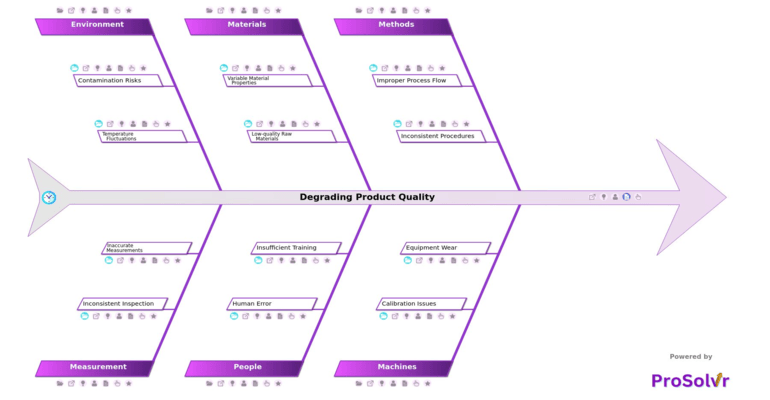
Root Cause Analysis of Degrading Product Quality
Degrading Product Quality is a serious issue in manufacturing that affects consistency, reliability, and customer trust. It does not happen suddenly. It develops slowly when small gaps in processes, machines, materials, or controls are ignored. Over time, these gaps lead to defects, rework, higher costs, and repeated production problems that teams struggle to permanently fix.
Many cases of Degrading Product Quality begin in Methods. Improper process flow, unclear work instructions, inconsistent procedures, and a lack of SOP updates create variation between batches. Machine-related problems such as calibration issues, an irregular calibration schedule, equipment wear, and insufficient maintenance further increase instability. Without a structured way to analyze these factors together, teams often fix only surface-level issues instead of the real root cause.
Materials, People, Environment, and Measurement systems also contribute to degrading product quality. Variable material properties, poor storage conditions, low-quality raw materials, and unverified suppliers introduce early defects. Human error, high workload, insufficient training, and lack of skill assessment increase operational risk. Contamination risks, an unclean workspace, temperature fluctuations, poor HVAC control, inconsistent inspection, lack of standardized checks, inaccurate measurements, and faulty measurement tools make it difficult to detect problems in time.
To truly stop degrading product quality, organizations need structured Root Cause Analysis, strong CAPA execution, and collaborative problem solving across departments. ProSolvr is a Gen-AI powered visual problem collaboration application that helps teams clearly identify root causes, organize insights visually, and work together in one platform. It enables structured RCA, supports corrective and preventive actions, and ensures problems are resolved permanently instead of repeatedly fixed.
Who can learn from the Degrading Product Quality template?
- Production Managers: They can gain insights into how process-related gaps contribute to product quality issues and use the findings to streamline workflows, improve procedural consistency, and enhance operational oversight.
- Maintenance Teams: They can understand how equipment-related shortcomings impact quality and use the RCA to strengthen preventive maintenance, improve equipment reliability, and reduce unplanned downtime.
- Quality Assurance (QA) Teams: They can learn from the analysis how weaknesses in inspection, measurement, and verification lead to defects, helping them improve quality control protocols and enhance detection mechanisms.
- Procurement & Supply Chain Teams: They benefit by understanding how material-related factors affect manufacturing quality, leading them to improve supplier evaluation, material handling, and incoming quality checks.
- Training & HR Departments: They can use RCA insights to identify competency gaps, refine training programs, improve onboarding processes, and ensure that employees have the skills needed to maintain consistent quality.
- Environmental Health & Safety (EHS) Teams: They can learn how environmental and workplace conditions influence product quality and apply these insights to strengthen environmental controls, hygiene standards, and safety practices.
Why use this template?
A dedicated RCA application like ProSolvr, which integrates fishbone diagrams with GEN-AI and Six Sigma logic, enables manufacturing teams to conduct deeper and more structured analyses. ProSolvr guides users through the cause-identification process, helps connect related causes and assists in deriving targeted, effective CAPA recommendations. By organizing complex manufacturing issues into a clear visual structure, it enables teams to understand not just what went wrong, but why it happened and how to prevent it in the future.
Use ProSolvr by smartQED to successfully identify the causes behind degrading product quality and eliminate them entirely for the growth and benefit of your manufacturing plant.


