






ProSolvr logo

Resolve problems, permanently

Root Cause Analysis of Budget Overruns

Root Cause Analysis of Budget Overruns

Budget overruns occur when the actual cost of a project, program, or operation exceeds the originally approved budget. In the finance domain, budget overruns are serious because they affect cash flow, profitability, forecasting accuracy, and stakeholder confidence. When budgets are exceeded, organizations may need to divert funds from strategic initiatives, increase borrowing, or reduce essential investments. Over time, repeated budget overruns can weaken financial discipline, reduce return on investment, and damage credibility with investors, auditors, and regulators.

Many budget overruns begin during the planning stage of a financial project. Unexplained project requirements, requirements lacking sufficient detail, inaccurate cost estimation, and reliance on incomplete or outdated cost benchmarks can cause budgets to be misaligned from the start. These planning gaps may allow hidden scope elements to surface later in the project. As a result, finance and project teams may struggle to control spending once commitments have already been made.

Management, resources, procurement, and execution issues can also increase budget overruns. Ineffective decision making, prolonged approval cycles, poor project governance, and absence of real time budget tracking can delay corrective action. High labor costs, excessive overtime, underestimated resource needs, skill complexity, and learning curves can further increase project costs. Procurement delays, delayed technical specifications, vendor cost escalation, weak contract clauses, low productivity, inefficient task sequencing, process bottlenecks, and incomplete review can all create additional financial pressure. External factors such as regulatory changes, compliance driven design modifications, market price fluctuations, and sudden increases in material and service costs can make budget overruns harder to prevent.

A Gen AI powered root cause analysis using a fishbone diagram and Six Sigma based thinking can help teams identify the real causes behind budget overruns. ProSolvr supports structured root cause analysis, stronger CAPA, better project governance, real time budget tracking, clearer accountability, and long term prevention of repeated budget overruns.

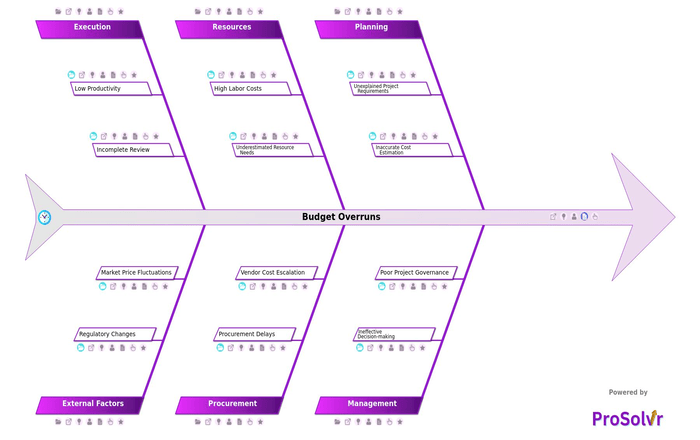
Budget Overruns

    • Planning
      • Unexplained Project Requirements
        • Requirements lacking sufficient detail
      • Inaccurate Cost Estimation
        • Reliance on incomplete or outdated cost benchmarks
    • Management
      • Ineffective Decision-making
        • Prolonged approval cycles for budget and scope changes
      • Poor Project Governance
        • Absence of real-time budget tracking and escalation mechanisms
    • Resources
      • High Labor Costs
        • Excessive overtime due to poor workload planning
      • Underestimated Resource Needs
        • Failure to account for skill complexity and learning curves
    • Procurement
      • Procurement Delays
        • Delayed finalization of technical specifications and RFQs
      • Vendor Cost Escalation
        • Contracts lacking fixed-price or escalation control clauses
    • Execution
      • Low Productivity
        • Inefficient task sequencing and process bottlenecks
      • Incomplete Review
        • Inadequate quality checks during early execution phases
    • External Factors
      • Regulatory Changes
        • Unplanned compliance-driven design and process modifications
      • Market Price Fluctuations
        • Sudden increases in material and service costs

Suggested Actions Checklist

Here are some corrective, preventive and investigative actions that organizations may find useful.

    • Planning
      • Unexplained Project Requirements
        • Corrective Actions:
          • Conduct a requirements clarification workshop to formally document and baseline all project requirements.
        • Preventive Actions:
          • Implement a standardized requirements definition and approval checklist before budget finalization.
        • Investigative Actions:
          • Review past change requests to identify gaps in initial requirement definition.
      • Inaccurate Cost Estimation
        • Corrective Actions:
          • Rework the project budget using revised estimates validated by cross-functional experts.
        • Preventive Actions:
          • Mandate multi-level cost estimation reviews using standardized estimation methodologies.
        • Investigative Actions:
          • Analyze estimation assumptions to identify sources of variance from actual costs.
    • Management
      • Ineffective Decision-making
        • Corrective Actions:
          • Escalate pending budget decisions to a steering committee for immediate resolution.
        • Preventive Actions:
          • Define clear decision rights and timelines within the project governance framework.
        • Investigative Actions:
          • Assess decision logs to identify delays and decision bottlenecks.
      • Poor Project Governance
        • Corrective Actions:
          • Establish an interim governance structure with defined budget oversight roles.
        • Preventive Actions:
          • Implement a formal project governance model with periodic budget reviews.
        • Investigative Actions:
          • Review governance charters and meeting records to identify control gaps.
    • Resources
      • High Labor Costs
        • Corrective Actions:
          • Reallocate work to optimize staffing levels and reduce excessive overtime.
        • Preventive Actions:
          • Introduce workforce planning aligned with realistic project schedules.
        • Investigative Actions:
          • Analyze labor cost trends to identify drivers of cost overruns.
      • Underestimated Resource Needs
        • Corrective Actions:
          • Augment the project team with required skills to stabilize execution.
        • Preventive Actions:
          • Incorporate resource complexity and skill requirements into planning templates.
        • Investigative Actions:
          • Compare planned versus actual resource utilization to identify estimation errors.
    • Procurement
      • Procurement Delays
        • Corrective Actions:
          • Fast-track critical procurements through management-approved expediting measures.
        • Preventive Actions:
          • Establish procurement lead-time buffers within the project schedule.
        • Investigative Actions:
          • Review procurement timelines to identify recurring delay points.
      • Vendor Cost Escalation
        • Corrective Actions:
          • Renegotiate contracts or seek alternative suppliers to control cost increases.
        • Preventive Actions:
          • Standardize contract clauses addressing price escalation and cost caps.
        • Investigative Actions:
          • Analyze contract terms and historical vendor pricing changes.
    • Execution
      • Low Productivity
        • Corrective Actions:
          • Re-sequence tasks to remove execution bottlenecks and improve workflow.
        • Preventive Actions:
          • Implement productivity benchmarks and routine performance monitoring.
        • Investigative Actions:
          • Assess work logs and cycle times to identify inefficiencies.
      • Incomplete Review
        • Corrective Actions:
          • Halt affected activities and correct defects before proceeding further.
        • Preventive Actions:
          • Introduce mandatory quality checkpoints in early execution stages.
        • Investigative Actions:
          • Review defect and rework records to determine root contributors.
    • External Factors
      • Regulatory Changes
        • Corrective Actions:
          • Update designs and processes to meet new regulatory requirements with revised budgets.
        • Preventive Actions:
          • Establish a regulatory monitoring mechanism during project planning and execution.
        • Investigative Actions:
          • Review regulatory change timelines to assess impact on project scope and cost.
      • Market Price Fluctuations
        • Corrective Actions:
          • Revise procurement strategies to mitigate immediate cost increases.
        • Preventive Actions:
          • Include contingency provisions for market volatility in future budgets.
        • Investigative Actions:
          • Analyze market price trends against procurement timing to assess exposure.
 

Who can learn from the Budget Overruns template?

  • Finance & Accounting Teams: They can better understand how planning gaps, inaccurate cost estimation, and market price fluctuations contribute to budget overruns, enabling stronger budgeting, forecasting, and financial controls.
  • Project Managers & Program Managers: Insights into causes such as unexplained project requirements, rework, low productivity, and procurement delays help them improve scope management, scheduling, and execution discipline.
  • Senior Management & Business Leaders: By reviewing issues like ineffective decision-making and poor project governance, leaders can strengthen approval processes, escalation mechanisms, and accountability structures.
  • Procurement & Contract Management Teams: Learning from vendor cost escalation, delayed RFQs, and contracts lacking fixed-price clauses allows them to negotiate better terms and reduce cost uncertainty.
  • Operations & Execution Teams: Understanding execution-level causes such as inefficient task sequencing and inadequate early quality checks helps improve productivity and reduce rework-related cost overruns.
  • Risk Management & Compliance Professionals: They can use insights from regulatory changes and compliance-driven modifications to improve risk anticipation, contingency planning, and preventive financial controls.

Why use this template?

ProSolvr helps finance and project teams collaboratively map causes responsible for the budget overruns. By guiding users through disciplined cause identification aligned with Six Sigma principles, the application supports consistent analysis, documentation, and alignment on CAPA decisions. As a result, organizations move beyond reactive cost containment and toward sustainable financial control and continuous improvement in managing budgets.

Use ProSolvr by smartQED to effectively track and manage budget within your organization.

Curated from community experience and public sources:

  • https://activecollab.com/blog/growth/what-is-budget-cost-overrun
  • https://activecollab.com/blog/growth/what-is-budget-cost-overrun
