







Root Cause Analysis of Recurring Audit Issues
Recurring audit issues refer to repeated audit findings, control gaps, or compliance failures that appear across multiple audits over time. In finance and other regulated industries, these issues are serious because they affect compliance, financial integrity, risk management, and stakeholder confidence. When the same findings return, it often means that deeper problems were not resolved. Recurring Audit Issues may lead to regulatory scrutiny, penalties, higher compliance costs, reputational damage, and reduced trust among investors, regulators, and customers.
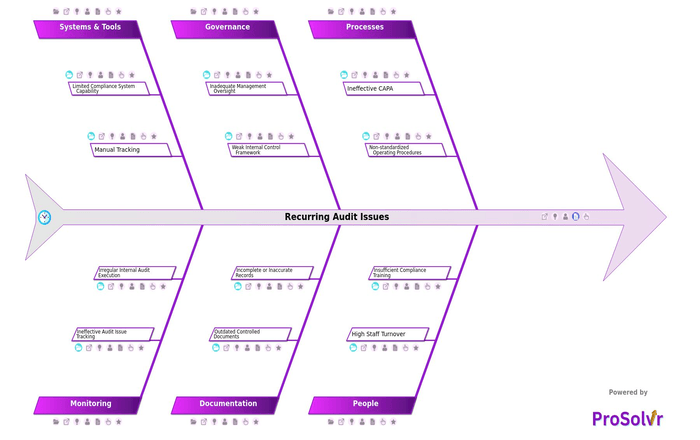
Many recurring audit issues begin under Processes, especially when organizations rely on ineffective corrective and preventive actions (CAPA). In such cases, root cause analysis conducted at a superficial level addresses symptoms instead of true causes. Problems may also continue because of non-standardized operating procedures and the absence of formally approved and controlled SOPs. Under People, high staff turnover can create knowledge gaps when knowledge transfer is not formalized during role transitions. These risks increase further when there is insufficient compliance and audit training or training programs not aligned with current regulatory expectations.
Governance weaknesses also contribute to recurring audit issues. Inadequate management oversight means audit outcomes are not reviewed or escalated at leadership level, so systemic problems remain unresolved. A weak internal control framework creates additional risk when controls are not designed to detect or prevent non-compliance. Documentation issues such as outdated controlled documents, change management process not enforced for document updates, incomplete or inaccurate records, and supporting evidence not consistently retained or verified can make audit findings harder to close and easier to repeat.
ProSolvr helps teams address these challenges through Gen-AI powered root cause analysis, fishbone diagrams, and Six Sigma-based thinking, enabling stronger CAPA, better ownership, improved evidence tracking, and long-term prevention of recurring audit issues.
Who can learn from the Recurring Audit Issues template?
- Finance and Accounting Professionals: They can better understand how process gaps, documentation weaknesses, and ineffective controls contribute to recurring audit findings, helping them improve financial accuracy and compliance.
- Internal Audit Teams: Auditors can use the RCA to strengthen audit planning, identify systemic issues beyond isolated findings, and improve follow-up on corrective and preventive actions.
- Compliance and Risk Management Teams: This group can learn how weaknesses in CAPA, training, and monitoring lead to repeated non-compliance, enabling them to design more robust compliance frameworks.
- Senior Management and Governance Bodies: Leaders and board members can see how inadequate oversight, weak escalation mechanisms, and poor review of audit outcomes drive recurring issues, reinforcing the need for stronger governance.
- Process Owners and Operations Managers: They can identify where non-standardized procedures, lack of controlled SOPs, and manual tracking methods create execution risks, and take ownership of sustainable process improvements.
- IT and Systems Support Teams: Technology teams can understand how limited compliance system capabilities, lack of audit trails, and reliance on manual tools affect audit readiness, guiding better system design and support.
Why use this template?
A root cause analysis application like ProSolvr, which uses a fishbone diagram, can significantly support this analysis and problem-solving process. Such an application provides a structured, visual way to capture and organize causes, ensuring consistency and completeness in post-incident analysis. By guiding teams through established cause categories and linking them logically to audit findings, ProSolvr helps prevent superficial analysis and promotes cross-functional collaboration.
Use ProSolvr by smartQED to efficiently root out your audit issues to recover your finances in your organization.


