






ProSolvr logo

Resolve problems, permanently

Automation Issues Root Cause Analysis

Root Cause Analysis of Automation Issues

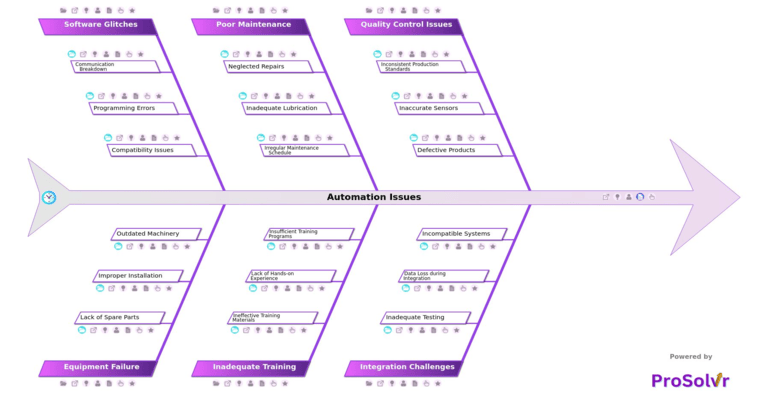
Automation issues in manufacturing disrupt production efficiency, quality, and operational stability. It refers to failures, inconsistencies, or inefficiencies within automated systems, equipment, or workflows that depend on technology-driven processes. These issues often begin with quality control issues and inconsistent production standards that allow small deviations to grow into larger failures. Variation in operator interpretation of SOPs, inaccurate sensors, and sensor drift due to prolonged exposure to harsh conditions can result in defective products and undetected micro-defects during visual inspection. When automation issues are ignored, they quickly affect productivity, safety, and customer satisfaction.

Many Automation Issues arise from integration challenges and inadequate testing. Limited test cases that fail to cover edge scenarios, data loss during Integration, missing validation rules for data transfer, and incompatible systems caused by the use of outdated interface protocols disrupt coordination between machines. In addition, software glitches such as communication breakdown, improper handling of network timeouts in code, programming errors, missing exception handling in critical modules, and compatibility issues due to deprecated libraries weaken automation reliability.

Poor maintenance is another major cause of automation Issues. Neglected repairs, repair requests not logged due to administrative oversight, inadequate lubrication, incorrect lubricant grade stored in inventory, and an irregular maintenance schedule without automated reminders increase the risk of equipment failure. Lack of spare parts due to procurement delays from single-source suppliers, improper installation caused by uncalibrated installation tools, and outdated machinery with deferred upgrade approvals further reduce system performance and stability.

Automation Issues also stem from inadequate training and insufficient training programs. Ineffective training materials, Outdated reference guides not revised after process changes, and lack of hands-on experience due to limited access to practice equipment reduce operator confidence and accuracy. To permanently eliminate automation issues, organizations need structured Root Cause Analysis supported by strong CAPA execution.

ProSolvr is a Gen-AI powered visual problem collaboration application that helps teams systematically identify root causes, connect technical and operational factors, and help organizations implement corrective and preventive actions that prevent recurring automation failures and ensure long term manufacturing stability.


Automation Issues

    • Quality Control Issues
      • Inconsistent Production Standards
        • Variation in operator interpretation of SOPs
      • Inaccurate Sensors
        • Sensor drift due to prolonged exposure to harsh conditions
      • Defective Products
        • Undetected micro-defects during visual inspection
    • Integration Challenges
      • Inadequate Testing
        • Limited test cases that fail to cover edge scenarios
      • Data Loss during Integration
        • Missing validation rules for data transfer
      • Incompatible Systems
        • Use of outdated interface protocols
    • Poor Maintenance
      • Neglected Repairs
        • Repair requests not logged due to administrative oversight
      • Inadequate Lubrication
        • Incorrect lubricant grade stored in inventory
      • Irregular Maintenance Schedule
        • Absence of automated reminders for scheduled servicing
    • Inadequate Training
      • Ineffective Training Materials
        • Outdated reference guides not revised after process changes
      • Lack of Hands-on Experience
        • Limited access to functional practice equipment
      • Insufficient Training Programs
        • Training budget cuts reducing session frequency
    • Software Glitches
      • Communication Breakdown
        • Improper handling of network timeouts in code
      • Programming Errors
        • Missing exception handling in critical modules
      • Compatibility Issues
        • Use of deprecated libraries in the application
    • Equipment Failure
      • Lack of Spare Parts
        • Procurement delays due to single-source suppliers
      • Improper Installation
        • Misalignment caused by uncalibrated installation tools
      • Outdated Machinery
        • Deferred upgrade approvals from management

Suggested Actions Checklist

Here are some corrective actions, preventive actions and investigative actions that organizations may find useful:

    • Quality Control Issues
      • Inconsistent Production Standards
        • Corrective Actions:
          • Standardize SOPs and conduct a focused retraining session to align operator interpretation.
        • Preventive Actions:
          • Implement periodic cross-audits to ensure consistent SOP adherence across shifts and teams.
        • Investigative Actions:
          • Review historical production logs and deviation reports to identify patterns of variability.
      • Inaccurate Sensors
        • Corrective Actions:
          • Replace faulty sensors and recalibrate all similar units in the production line.
        • Preventive Actions:
          • Introduce scheduled sensor calibration intervals based on operating environment.
        • Investigative Actions:
          • Analyze environmental exposure conditions and maintenance history to determine root cause of drift.
      • Defective Products
        • Corrective Actions:
          • Re-inspect affected batches using enhanced detection techniques such as magnified or automated inspection.
        • Preventive Actions:
          • Upgrade inspection systems with automated defect-detection tools.
        • Investigative Actions:
          • Conduct a failure mode review to identify why micro-defects bypassed visual checks.
    • Integration Challenges
      • Inadequate Testing
        • Corrective Actions:
          • Expand the testing suite to include missing edge-case scenarios.
        • Preventive Actions:
          • Establish a mandatory test coverage threshold before integration approval.
        • Investigative Actions:
          • Perform a gap analysis of existing test cases versus real-world failure scenarios.
      • Data Loss during Integration
        • Corrective Actions:
          • Patch integration scripts to include required validation rules.
        • Preventive Actions:
          • Implement a standardized validation framework for all data transfer modules.
        • Investigative Actions:
          • Trace recent integration logs to pinpoint where validation gaps allowed data loss.
      • Incompatible Systems
        • Corrective Actions:
          • Update or replace outdated interface protocols across affected modules.
        • Preventive Actions:
          • Set a governance policy requiring periodic compatibility assessments for all systems.
        • Investigative Actions:
          • Map interface dependencies to identify how outdated protocols affected communication.
    • Poor Maintenance
      • Neglected Repairs
        • Corrective Actions:
          • Immediately log and address pending repair requests and rectify damaged components.
        • Preventive Actions:
          • Introduce a digital repair-request tracking system with automated alerts.
        • Investigative Actions:
          • Audit maintenance records to determine why repair requests were overlooked.
      • Inadequate Lubrication
        • Corrective Actions:
          • Replace incorrect lubricant and re-lubricate affected equipment.
        • Preventive Actions:
          • Implement controlled storage and labeling for lubricants with grade verification before use.
        • Investigative Actions:
          • Review inventory management practices to identify how incorrect lubricant grade was stocked.
      • Irregular Maintenance Schedule
        • Corrective Actions:
          • Execute overdue maintenance tasks and update the maintenance registry.
        • Preventive Actions:
          • Deploy an automated maintenance scheduling system with compliance tracking.
        • Investigative Actions:
          • Analyze frequency and causes of missed maintenance tasks to detect systemic issues.
    • Inadequate Training
      • Ineffective Training Materials
        • Corrective Actions:
          • Update outdated training manuals and distribute revised materials immediately.
        • Preventive Actions:
          • Set a periodic review cycle for all training documentation.
        • Investigative Actions:
          • Compare old materials against current processes to determine gaps.
      • Lack of Hands-on Experience
        • Corrective Actions:
          • Arrange supervised practical sessions using functional equipment.
        • Preventive Actions:
          • Allocate dedicated training assets for continuous hands-on learning.
        • Investigative Actions:
          • Assess training logs to understand the extent of hands-on exposure across trainees.
      • Insufficient Training Programs
        • Corrective Actions:
          • Reinstate essential training sessions by reallocating budget or optimizing resources.
        • Preventive Actions:
          • Implement a minimum training frequency policy protected from budget fluctuations.
        • Investigative Actions:
          • Review budget decisions to determine how and why training frequency was reduced.
    • Software Glitches
      • Communication Breakdown
        • Corrective Actions:
          • Update communication modules to handle network timeouts correctly.
        • Preventive Actions:
          • Include robust communication-handling protocols in future software designs.
        • Investigative Actions:
          • Review network logs and timeout occurrences to identify root communication failures.
      • Programming Errors
        • Corrective Actions:
          • Patch modules with missing exception handling and re-test functionality.
        • Preventive Actions:
          • Enforce mandatory code reviews focusing on exception management.
        • Investigative Actions:
          • Analyze commit history to determine how the error entered production.
      • Compatibility Issues
        • Corrective Actions:
          • Replace deprecated libraries with supported, updated versions.
        • Preventive Actions:
          • Introduce a compatibility checklist for all software updates and deployments.
        • Investigative Actions:
          • Examine dependency maps to understand the impact of deprecated libraries.
    • Equipment Failure
      • Lack of Spare Parts
        • Corrective Actions:
          • Procure required spare parts immediately and restore equipment functionality.
        • Preventive Actions:
          • Establish multi-vendor sourcing and maintain minimum stock levels.
        • Investigative Actions:
          • Review procurement lead times and supply-chain constraints.
      • Improper Installation
        • Corrective Actions:
          • Reinstall equipment using calibrated tools and supervised procedures.
        • Preventive Actions:
          • Include installation calibration checks in the commissioning SOPs.
        • Investigative Actions:
          • Verify installation logs to identify the cause of misalignment.
      • Outdated Machinery
        • Corrective Actions:
          • Repair or temporarily retrofit machinery until upgrades are approved.
        • Preventive Actions:
          • Implement an equipment lifecycle management program with scheduled upgrades.
        • Investigative Actions:
          • Review asset aging reports to assess delays in upgrade approvals.
 

Who can learn from the Automation Issues template?

  • Manufacturing Engineers: They can gain insights into automation-related failures such as inaccurate sensors, improper installation, and system incompatibilities, helping them design more reliable and stable automated processes.
  • Quality Assurance Teams: They can better understand how issues like inconsistent production standards and undetected micro-defects impact product quality, enabling them to strengthen quality control methods.
  • Maintenance Teams: They can learn from causes related to neglected repairs, inadequate lubrication, and irregular maintenance schedules, helping them improve preventive maintenance practices and equipment reliability.
  • Software Development and Automation Programmers: They can benefit from identifying programming errors, communication breakdowns, and compatibility issues, ensuring that control systems and automation software are more robust.
  • Training and Workforce Development Teams: They can identify gaps such as ineffective training materials and lack of hands-on experience, guiding them to design stronger training programs for operators and technicians.
  • Operations and Production Managers: They can understand how management decisions, resource allocation, outdated machinery, or supply delays contribute to automation issues, enabling better planning, oversight, and risk mitigation.

Why use this template?

ProSolvr guides teams through the causal breakdown, ensuring that issues are detected and linked appropriately to the automation failure. With its structured interface and methodical workflows, ProSolvr enables faster, clearer decision-making and helps organizations transform complex automation failures into actionable improvement strategies. This leads to stronger manufacturing systems, improved reliability, and long-term operational resilience.

Use ProSolvr by smartQED for effectively rooting out problems during manufacturing processes in your organization.

Curated from community experience and public sources:

  • https://quixy.com/blog/automation-struggles-in-manufacturing-industry/
  • https://masterlinqueautomation.com/the-benefits-and-challenges-of-adopting-automation-in-manufacturing-industries.php
