






ProSolvr logo

Resolve problems, permanently

Defective Circuit Boards Root Cause Analysis

Root Cause Analysis of Defective Circuit Boards

A high rate of defective circuit boards can slow down production, inflate rework costs, and weaken product reliability. Many failures begin with material issues such as contaminated materials, poor quality components, or incorrect specifications. Improper storage that exposes PCBs to dust, moisture, or oxidation further increases the likelihood of early failures. Supplier defects can silently slip into the line, creating widespread, hard-to-detect issues that disrupt even the most streamlined manufacturing processes. When these material-related problems go unchecked, they create a chain reaction that affects throughput, product consistency, and customer satisfaction.

During assembly, improper methods often amplify defects. Rough handling leads to physical damage, while a lack of ESD protection results in electrostatic discharge that permanently harms sensitive components. Soldering mistakes caused by insufficient flux application or incorrect temperature settings frequently produce weak joints, bridging, or intermittent failures. These method-level weaknesses are compounded by manpower challenges such as insufficient training, poor troubleshooting skills, and operator errors. When operators are not confidently equipped to handle PCBs or correctly set up machines, the likelihood of recurring defects grows quickly.

Machine-related factors remain another significant contributor to PCB failures. A misaligned pick-and-place machine, nozzle blockages, incorrect component placement, faulty soldering equipment, worn-out soldering tips, and inconsistent heat application can affect hundreds of boards within minutes. Measurement issues such as inconsistent inspection procedures, inaccurate testing equipment, false result patterns, and AOI calibration problems make it even harder to detect defects before they reach customers. These gaps allow defective boards to pass through the line undetected, creating avoidable scrap and warranty risks. Environmental influences such as excessive dust, vibration, temperature swings, humidity fluctuations, and poor grounding conditions further destabilize PCB reliability and impact soldering quality.

Organizations seeking long-term improvement turn to structured, intelligence-driven RCA to break the cycle of recurring failures. A GEN AI powered approach combined with fishbone diagrams and Six Sigma principles helps teams map issues across materials, methods, machines, manpower, measurement, and environment with remarkable clarity. ProSolvr brings this entire workflow into a powerful digital platform where engineers can uncover hidden causes and implement strong corrective and preventive actions. By integrating AI insights with proven RCA methodology, ProSolvr enables manufacturers to reduce PCB defects, accelerate investigations, and build a culture of consistent, high-quality production.


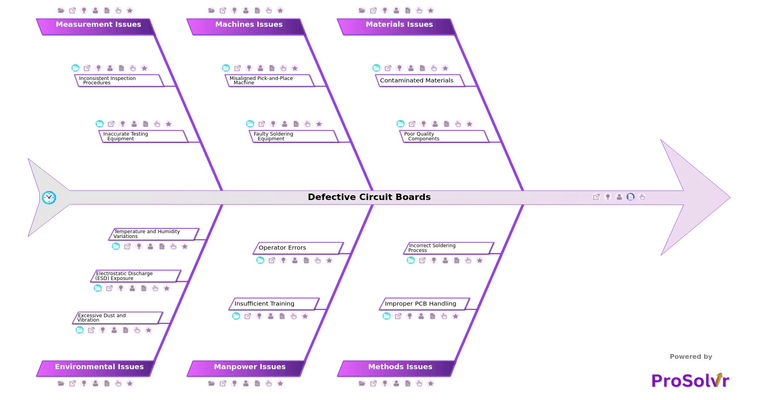
Defective Circuit Boards

    • Materials Issues
      • Contaminated Materials
        • Improper Storage Conditions
        • Dust, Moisture, or Oxidation on PCBs
      • Poor Quality Components
        • Incorrect Specifications
        • Supplier Defects
    • Methods Issues
      • Improper PCB Handling
        • Rough Handling Causing Physical Damage
        • Electrostatic Discharge (ESD) Damage
      • Incorrect Soldering Process
        • Insufficient Flux Application
        • Wrong Soldering Temperature Settings
    • Machines Issues
      • Misaligned Pick-and-Place Machine
        • Nozzle Blockage Causing Misplacement
        • Incorrect Component Placement
      • Faulty Soldering Equipment
        • Worn-out Soldering Tips
        • Inconsistent Heat Application
    • Manpower Issues
      • Insufficient Training
        • Inadequate Troubleshooting Skills
        • Lack of Knowledge About PCB Handling
      • Operator Errors
        • Poor Soldering Techniques
        • Improper Machine Setup
    • Measurement Issues
      • Inconsistent Inspection Procedures
        • Lack of Clear Defect Classification
        • Variability in Visual Inspections
      • Inaccurate Testing Equipment
        • False Positives or Negatives in Defect Detection
        • Calibration Issues in AOI
    • Environmental Issues
      • Excessive Dust and Vibration
        • Presence of Worn-out Machinery, Loose Components, or Unbalanced Rotating Parts
        • Inadequate Ventilation & Housekeeping
      • Electrostatic Discharge (ESD) Exposure
        • High Static Buildup in Production Area
        • Ineffective Grounding or ESD Protection
      • Temperature and Humidity Variations
        • PCB Warping Due to Improper Storage
        • Impact on Soldering Quality

Suggested Actions Checklist

Here are some corrective actions, preventive actions and investigative actions that organizations may find useful:

    • Materials Issues
      • Contaminated Materials
        • Corrective Actions:
          • Implement strict material handling protocols to prevent contamination.
          • Inspect and clean contaminated materials before use to minimize defects.
        • Preventive Actions:
          • Improve storage conditions with controlled humidity and temperature environments.
          • Train staff on best practices for material handling and contamination prevention.
        • Investigative Actions:
          • Conduct root cause analysis on contamination sources (e.g., storage, transport, or supplier).
          • Test affected materials to determine the impact of contamination on PCB performance.
      • Poor Quality Components
        • Corrective Actions:
          • Replace defective components with correctly specified, high-quality parts.
          • Strengthen supplier quality control with rigorous incoming inspection standards.
        • Preventive Actions:
          • Develop and enforce stringent supplier qualification and auditing processes.
          • Establish a standardized component verification system before production.
        • Investigative Actions:
          • Analyze historical supplier defect rates and trends.
          • Conduct failure analysis on defective components to identify recurring issues.
    • Methods Issues
      • Improper PCB Handling
        • Corrective Actions:
          • Retrain staff on proper PCB handling techniques to prevent damage.
          • Implement protective handling tools such as ESD-safe gloves and storage trays.
        • Preventive Actions:
          • Introduce standard operating procedures (SOPs) for PCB handling.
          • Install ESD protection measures in handling and assembly areas.
        • Investigative Actions:
          • Audit handling practices to identify gaps in training and execution.
          • Analyze damage trends to correlate handling mistakes with failure rates.
      • Incorrect Soldering Process
        • Corrective Actions:
          • Adjust flux application procedures to ensure proper soldering quality.
          • Recalibrate soldering stations to maintain the correct temperature settings.
        • Preventive Actions:
          • Implement a process control system to monitor soldering parameters in real-time.
          • Conduct regular refresher training for operators on soldering best practices.
        • Investigative Actions:
          • Perform defect analysis on soldered PCBs to identify common failure points.
          • Benchmark soldering process parameters against industry best practices.
    • Machines Issues
      • Misaligned Pick-and-Place Machine
        • Corrective Actions:
          • Clean and unclog pick-and-place nozzles to ensure accurate placement.
          • Realign the machine to correct placement errors and improve accuracy.
        • Preventive Actions:
          • Implement routine maintenance and calibration schedules for pick-and-place machines.
          • Use automated vision inspection to detect misalignments in real-time.
        • Investigative Actions:
          • Analyze misplacement frequency to determine machine reliability.
          • Identify specific nozzles or machine components causing repeated issues.
      • Faulty Soldering Equipment
        • Corrective Actions:
          • Replace worn-out soldering tips to ensure consistent heat transfer.
          • Repair or replace faulty heating elements in soldering equipment.
        • Preventive Actions:
          • Establish a preventive maintenance schedule for soldering equipment.
          • Use temperature monitoring sensors to ensure uniform heating.
        • Investigative Actions:
          • Conduct thermal profiling analysis to assess heat distribution variations.
          • Compare soldering defects across different machines to identify problem units.
    • Manpower Issues
      • Insufficient Training
        • Corrective Actions:
          • Conduct immediate training sessions for operators on PCB troubleshooting and handling.
          • Provide hands-on experience with guided supervision to improve competency.
        • Preventive Actions:
          • Develop a structured training program with certification for PCB assembly staff.
          • Regularly update training materials to align with technological advancements.
        • Investigative Actions:
          • Evaluate training effectiveness through assessments and defect trend analysis.
          • Conduct skill gap analysis to identify areas needing further improvement.
      • Operator Errors
        • Corrective Actions:
          • Implement real-time process monitoring to catch and correct errors early.
          • Conduct targeted coaching for operators with repeated mistakes.
        • Preventive Actions:
          • Introduce automated assistance tools to reduce human errors in soldering and machine setup.
          • Use checklists and visual aids to ensure process adherence.
        • Investigative Actions:
          • Analyze defect rates by operator to identify patterns of errors.
          • Review past training effectiveness and update materials based on findings.
    • Measurement Issues
      • Inconsistent Inspection Procedures
        • Corrective Actions:
          • Standardize defect classification criteria to minimize subjectivity in inspections.
          • Implement automated optical inspection (AOI) systems to improve consistency.
        • Preventive Actions:
          • Train quality control teams on uniform defect detection methods.
          • Regularly update and enforce visual inspection SOPs.
        • Investigative Actions:
          • Compare inspection results from different inspectors to detect inconsistencies.
          • Analyze rejection rates across shifts to identify potential inspection biases.
      • Inaccurate Testing Equipment
        • Corrective Actions:
          • Calibrate testing equipment to eliminate false positives and negatives.
          • Replace aging or malfunctioning testing systems to maintain accuracy.
        • Preventive Actions:
          • Implement routine calibration schedules for all testing equipment.
          • Use redundancy testing with secondary systems to verify defect detection accuracy.
        • Investigative Actions:
          • Review past false detection cases to understand trends and root causes.
          • Conduct failure mode and effects analysis (FMEA) on test equipment reliability.
    • Environmental Issues
      • Excessive Dust and Vibration
        • Corrective Actions:
          • Clean production areas and improve ventilation to reduce dust accumulation.
          • Fix or replace unbalanced rotating parts to minimize excessive vibration.
        • Preventive Actions:
          • Implement regular housekeeping and maintenance schedules.
          • Install vibration monitoring systems on critical machinery.
        • Investigative Actions:
          • Conduct particle count tests to measure airborne contamination levels.
          • Analyze vibration-related failures to pinpoint sources of excessive movement.
      • Electrostatic Discharge (ESD) Exposure
        • Corrective Actions:
          • Install proper grounding measures in production areas.
          • Provide ESD-safe clothing and footwear to all personnel.
        • Preventive Actions:
          • Implement ESD protection zones with static-safe flooring and workstations.
          • Conduct regular ESD audits to ensure compliance with safety protocols.
        • Investigative Actions:
          • Measure static buildup levels in different areas of the production floor.
          • Analyze past PCB failures to determine ESD-related damage trends.
      • Temperature and Humidity Variations
        • Corrective Actions:
          • Adjust HVAC systems to maintain stable temperature and humidity conditions.
          • Use climate-controlled storage for sensitive PCB components.
        • Preventive Actions:
          • Install real-time environmental monitoring systems with alarms for deviations.
          • Develop material handling protocols to prevent exposure to fluctuating conditions.
        • Investigative Actions:
          • Conduct thermal imaging studies to assess heat-related defects.
          • Analyze the correlation between environmental fluctuations and PCB failure rates.
 

Who can learn from the Defective Circuit Boards template?

  • Manufacturing Engineers: They can use the analysis to optimize production processes, refine soldering techniques, and ensure machine calibration to minimize defects. Understanding root causes helps them implement preventive measures and improve product quality.
  • Quality Control Teams: By analyzing measurement and inspection issues, they can enhance defect detection methods, improve testing equipment calibration, and establish more consistent quality standards. This helps reduce false positives/negatives and ensures fewer defective boards reach customers.
  • Supply Chain & Procurement Teams: They can use the findings to evaluate supplier quality, enforce stricter component specifications, and ensure proper material handling. This reduces risks associated with poor-quality components and contaminated materials.
  • Production Line Operators: They gain insights into the importance of proper machine setup, correct soldering techniques, and careful PCB handling. Training based on the RCA helps them avoid common mistakes and maintain consistent production standards.
  • Design Engineers: Learning from defects in manufacturing helps them design PCBs that are easier to produce, reducing misalignment issues, soldering difficulties, and susceptibility to environmental factors. This leads to better manufacturability and higher reliability.
  • Maintenance & Equipment Technicians: They can identify recurring machine issues, such as misaligned pick-and-place equipment or faulty soldering stations, and implement proactive maintenance. This reduces unexpected downtime and ensures machines operate at peak efficiency.

Why use this template?

A high rate of defective circuit boards requires a clear and structured approach to find the real causes and fix them effectively. By completing a proper root cause analysis and then applying the right corrective and preventive actions, manufacturers can steadily reduce defects and improve overall product quality. This creates a continuous improvement cycle that strengthens processes and boosts efficiency across the production line.

ProSolvr makes this even easier by providing a collaborative platform where teams can analyze issues, document actions, and track improvements in one place. With GEN-AI powered RCA tools, ProSolvr helps identify root causes faster and supports more accurate and effective CAPA decisions.

Use ProSolvr by smartQED to solve problems efficiently and improve quality in your organization.

Curated from community experience and public sources:

  • https://www.mclpcb.com/pcb-guide/
  • https://www.linkedin.com/pulse/10-reasons-pcb-manufacturing-defects-how-eliminate-them-julia-z--fostc/
